Guides / Cost
Pre-Plated Strip or Plating After Stamping: How Cut Edges, Forming and Cost Decide
October 30, 2026
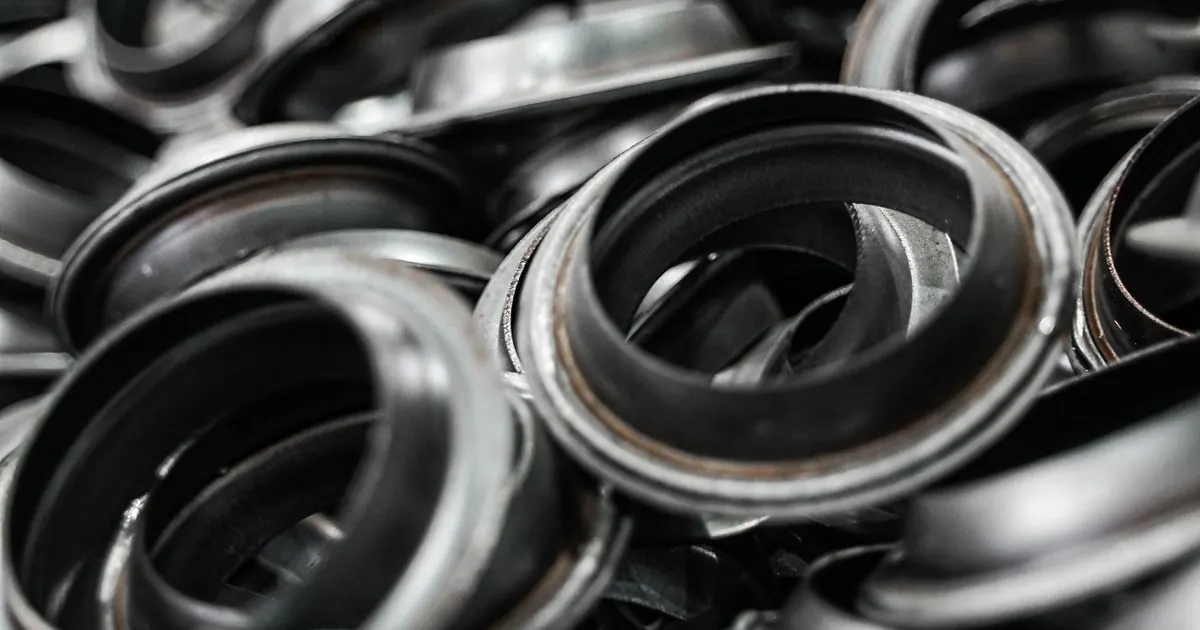
A plated finish can be added to a stamped part in two ways. The shop can buy strip that was plated before it reached the press, stamp it and ship the part with its coating already on. Or it can stamp bare strip and send the finished parts to a plater. The choice changes cost, edge protection, forming risk and lead time, and it is easy to get wrong because the two routes look alike on a drawing.
This guide compares pre-plated strip with plating after stamping, so you can decide before the RFQ goes out and avoid a requote.
How the two routes work
Pre-plated strip. A mill or strip plater coats the coil on a continuous line, often with tin, nickel, zinc, silver or gold, over a nickel underlayer where needed. The press cuts and forms the strip into parts. The plating covers the faces of the part as they were on the strip. The cut edges and any surface newly exposed by forming show base metal.
Plating after stamping. The shop stamps bare or oiled strip, cleans the parts and sends them to a plater. The plater coats the parts in racks, in barrels or on a continuous carrier strip. The coating covers every surface that the plating bath reaches, including the cut edges.
A third variant sits between them. Connector terminals are often stamped as a continuous strip, with the parts still attached to a carrier, and plated in that form. This combines the coverage of post-plating with the handling of a strip. It is common for high volume electronic parts.
The edge question
The most important difference is what happens at the cut edge. When the press cuts pre-plated strip, the cutting action leaves the base metal exposed along every cut. Depending on the coating, the plating may smear a little over the edge, but it does not cover it reliably.
What that means depends on the part:
- Steel with zinc. Zinc is sacrificial, so it offers some protection to a nearby bare steel edge, but the protection is limited in distance and time.
- Copper alloy with tin. The exposed copper edge can tarnish. For many electronic parts this does not matter, since the contact area is on the face. If the edge must solder, check that it does.
- Steel with nickel. The nickel gives no sacrificial protection, and a bare steel edge can rust.
- Gold. Gold is applied only where it is needed, and bare edges are expected.
If the part needs corrosion protection on the edge, a salt spray requirement or edge solderability, then plating after stamping is the safer route. A salt spray test such as ASTM B117 will show the edge as a failure point if it is not covered. State the test and the acceptance criteria on the print.
Forming and die effects
Plating is a thin layer on a metal that is then bent and drawn. It does not always keep up:
- Cracking and flaking. Hard platings such as nickel can crack at tight bends. Gold can flake off in draws.
- Smearing. Soft platings such as tin smear onto the tool and build up, marking parts and requiring cleaning.
- Wear on tools. Hard platings wear tools faster.
- Thickness loss. Stretching at a draw thins the plating along with the base metal.
Shops test a bend on the actual plated strip before committing, and they adjust the bend radius, the tooling surface and the lubricant. If a plating cracks at your required radius, the options are a softer plating, a larger radius or plating after forming. The secondary operations guide covers how finishing steps fit into the process.
Thickness and uniformity
Pre-plated strip carries a uniform coating on the faces, with thickness set and measured at the plater, usually by X-ray fluorescence. Specifications exist for common coatings. ASTM B545 covers electrodeposited tin, ASTM B633 covers zinc on iron and steel, ASTM B689 covers electroplated engineering nickel and ASTM B488 covers electrodeposited gold for engineering use. Name the standard, the thickness and the class on the print.
Parts plated after stamping can show uneven thickness. Plating builds up faster on edges and corners and slower in recesses and deep holes, so a cup or a part with blind holes may be thin inside. Racks leave contact marks where the part hangs. Barrel plating tumbles parts together, which suits small sturdy parts but can bend delicate ones and tangle springs. Specify the method if it matters.
Hydrogen embrittlement
High-strength steel parts that are electroplated can absorb hydrogen in the bath, which can make them brittle and crack under stress, sometimes days later. The risk rises with hardness, and spring steel parts are prime examples. The cure is a baking step after plating, covered by ASTM B850 for steel parts. Pre-plated strip does not avoid this concern, since the strip was plated before forming and hydrogen can still be in the metal. For hardened spring parts, discuss the process with the shop and the plater. The stamped spring clips article goes further.
Tin whiskers
Pure tin can grow thin conductive whiskers over time, which can short fine-pitch electronics. Matte tin, a nickel underplate, adequate thickness and reflow reduce the risk. If the part goes into electronics, state any whisker-mitigation requirement. This applies to both routes.
Cost compared
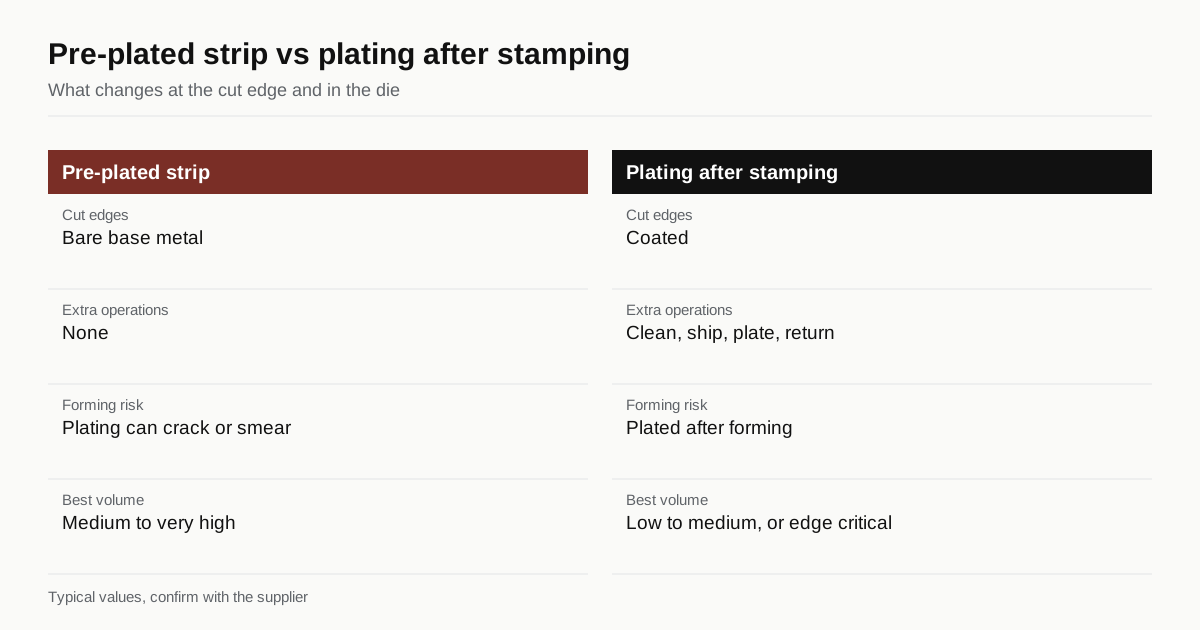
| Factor | Pre-plated strip | Plating after stamping |
|---|---|---|
| Material cost | Strip price carries a plating premium | Bare strip price |
| Extra operations | None | Cleaning, transport, plating, return |
| Lead time | Shorter if strip is stocked | Longer, extra handling and transit |
| Edge coverage | None | Yes |
| Forming risk | Plating can crack or smear | Plating applied after forming |
| Thickness uniformity | Uniform on faces | Varies with geometry |
| Best volume | Medium to very high | Low to medium, or when edges matter |
| Selective plating | Easy, such as gold stripe | Possible, with masking, at higher cost |
Ask for both quotes. The total includes the piece price, the plating cost, the transport and the handling. A strip premium of a few cents per part can beat a separate plating line at high volume, while low volume work often costs less to plate after stamping, since there is no need to buy a special coil.
Selective plating
Many electronic parts need a precious metal only at the contact area. Selective plating applies gold or silver to a stripe or spot on the strip, with a cheaper coating elsewhere. This saves a large amount of precious metal and is almost always done on strip before stamping. If the part has a contact area, say where it is and how large, so the shop can order strip with the right stripe position. Changing the position later means new strip and often a new die setup.
Minimum buys, lead time and handling
Each route has a logistics side. Pre-plated strip is bought from a mill or strip plater in coil lots, and plating lines often set minimum coil quantities for a given alloy, thickness, width and coating. A new, special coil can take weeks, and a shop that does not stock your spec has to order it. Once a shop holds the coil, lead time for the parts is short.
Plating after stamping adds a trip. Parts go to the plater, wait in the plater’s queue, are coated, inspected and shipped back. Two or three extra weeks is common if the plater is outside the shop, and the added handling gives scratches and mixed lots a chance to creep in. Delicate parts need separators or trays, and the packaging should be on the quote. If parts are bulk-packed after plating, ask how contact damage is controlled.
For a long program, the shop can arrange a stock of the right strip or schedule plating batches to cover several releases. Say how you plan to release orders, because it changes the best route. A part released in small monthly lots suits a stocked pre-plated coil. A part released in a few large lots may suit batch plating.
Compliance and passivation
Plated parts carry compliance questions. Electronics buyers commonly require compliance with restricted substance rules, which affects the choice of plating chemistry and the passivation on zinc. Hexavalent chromium passivates have been replaced in many programs by trivalent chromium types. If you need a certificate of compliance, say so on the print, and ask the shop to confirm that both the strip and the plater can supply the paperwork. For parts that go into regulated markets, request the certificate with the first shipment, not at the end of the program.
Lot traceability matters too. Pre-plated strip carries the plater’s lot number, and the shop can record it against the part lot. Parts plated after stamping carry the plater’s batch number. If you need traceability back to the coating lot, say so in the RFQ, because it changes record-keeping and sometimes the lot size.
What to put on the RFQ
- Plating type, thickness, standard and class
- Which surfaces need coverage, and whether edges must be covered
- Salt spray or solderability requirements
- Allowed plating method, such as rack, barrel or reel
- Bend radii and critical forms
- Material, temper and thickness of the base strip
- Whether you accept either route
- Annual volume
The metal stamping RFQ checklist covers the other fields. Ask for both routes in one quote so you can compare them directly.
Checklist before you choose
- Decide whether the cut edge needs coating.
- Check that the plating survives the forming on a test strip.
- Name the plating standard, thickness and test.
- Check hydrogen embrittlement risk for hard steel parts.
- Compare total cost of both routes at your volume.
- Plan selective plating if the part has a contact area.
When the print is ready, send the RFQ and compare shop replies within 24 business hours.
Frequently asked questions
Is pre-plated strip cheaper than plating after stamping?
Often, at high volume, because the strip is plated on a continuous line and the parts skip a separate plating operation. At low volume, or when edges must be covered, plating after stamping can cost less overall. Ask for both quotes.
Are the cut edges of pre-plated parts protected?
Not by the plating. Cutting exposes the base metal at the edge, and the plated layer covers only the original strip faces. For many parts this is fine. For parts that need edge corrosion protection or edge solderability, plating after stamping is safer.
Can pre-plated strip crack when it is bent?
Yes. Some platings, such as nickel and gold, can crack or flake at tight bends or in draws, and soft platings such as tin can smear and gall in the die. Test the bend on the actual strip.
Need a quote for this part?
Send the print. We match you with up to 3 stamping shops and reply within 24 business hours.
Send my RFQ