Guides / Process
Stamped Spring Clips: Spring Steel, Heat Treat Choices and Force Limits for Clip Parts
November 2, 2026
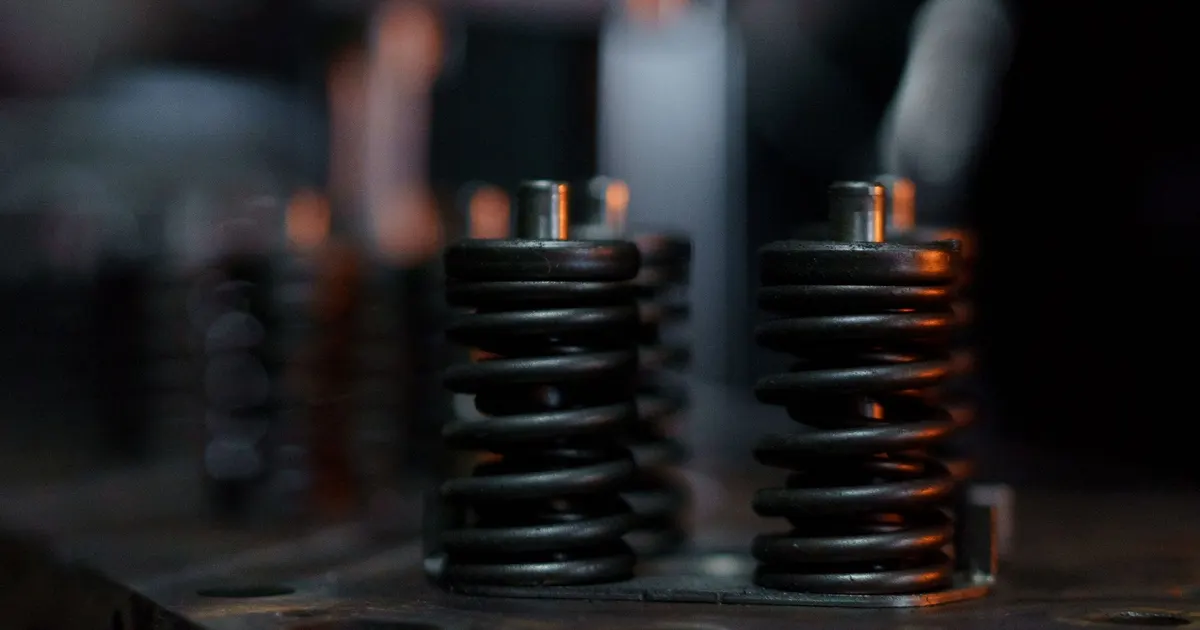
A spring clip is a small part with a big job. It snaps over a panel, grips a rod, holds a battery in place or retains a pin, and it must do so thousands of times without loosening. Unlike a bracket, which keeps its shape, a clip flexes and springs back. That needs a material that stays elastic, a bend design that does not crack and a heat treat that gives the right hardness.
Clips are among the most common parts stamped from spring steel strip. This guide covers the materials, the two heat treat routes, the design rules that keep a clip from cracking or losing force, and what to put on the RFQ.
What makes a clip a spring
A spring stores energy when it deflects and returns it when released. Two properties decide how well it does that. Yield strength sets how far the material can bend before it takes a permanent set. Modulus sets how much force a given deflection produces. Spring materials have very high yield strength compared with ordinary steel, so they can flex a lot without staying bent.
A clip works well when stress during use stays below the elastic limit by a safe margin. Pushed beyond that, the clip takes a set, loses grip and may crack after repeated use. Designers keep working stress to a fraction of the yield, often well under three quarters, and the stamper’s job is to deliver material and geometry that match the design.
Material options
| Material | Typical condition | Strengths | Limits |
|---|---|---|---|
| High carbon spring steel, such as 1075 or 1095 | Hardened and tempered | Highest strength per cost, good fatigue | Rusts, needs coating |
| Stainless 301 | Cold rolled to a spring temper | Corrosion resistant, strong when cold worked | Costlier, bend limits |
| Phosphor bronze | Hard to spring temper | Conducts, resists corrosion, good fatigue | Lower strength, higher cost |
| Beryllium copper | Aged after forming | Very high strength with conductivity | High cost, special handling |
| Low carbon steel | Annealed | Cheap, forms easily | Not a true spring, takes a set |
See stamping steel grades for the steel families, stainless steel stamping for 301, copper, brass and phosphor bronze strip for the bronze and beryllium copper stamping for the highest strength copper option. Choose by load, environment, conductivity and cost. Many clips that specify stainless or bronze by habit would work in coated spring steel, and the savings can be large.
Route one: pre-hardened strip
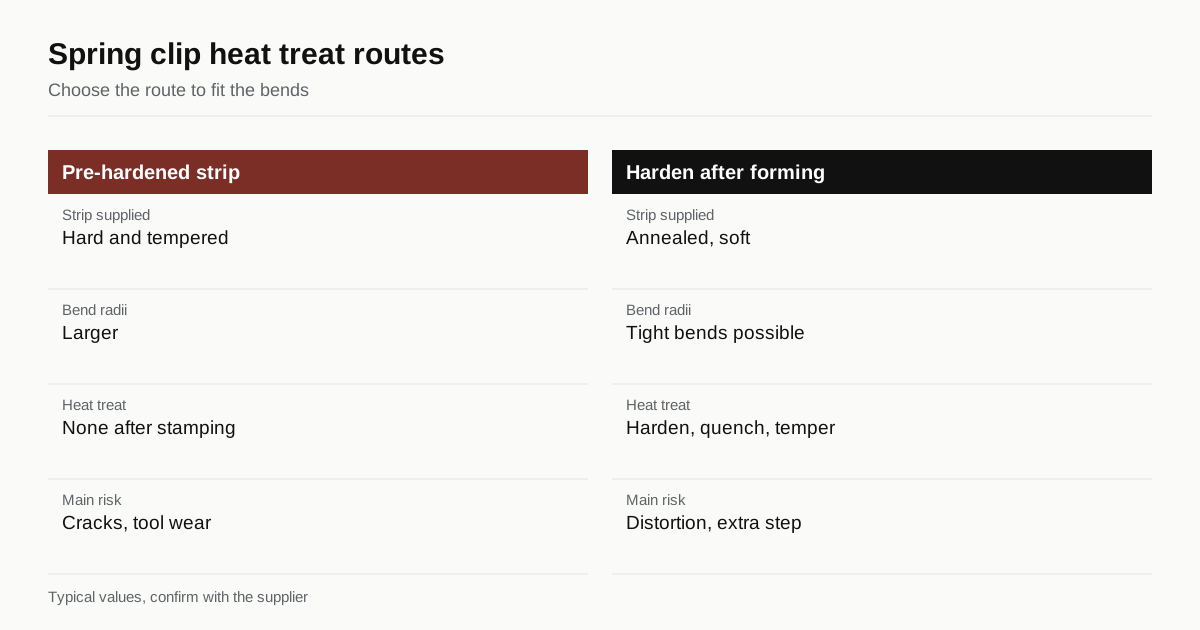
In this route, the strip is hardened and tempered before stamping. It arrives at its working hardness, often described as hard and tempered or, with a blue oxide surface, blue tempered. The shop stamps and forms it and ships the part, with no heat treatment afterward.
Advantages are no furnace step, no heat treat distortion and tighter dimensional control, since the part keeps the shape the die gave it. The costs are larger bend radii, because hard material cracks on tight bends, more tool wear and higher press force. A clip with gentle curves suits this route well.
Route two: harden after forming
In this route, the shop forms the clip from soft annealed strip, which allows tight bends and complex shapes. It then heats the parts to hardening temperature, quenches them and tempers them to the target hardness. Typical clip hardness falls in the mid-40s to low 50s on the Rockwell C scale, adjusted for the balance between strength and toughness.
Advantages are tight forming and complex shape. The costs are an extra process step, distortion from quenching, a possible oxide or decarburized layer to clean and a need for fixtures to hold shape. Heat treated clips need measurement afterward, since the part changes. Many shops send the heat treat out, which adds lead time.
A common choice rule: if the bends allow the pre-hardened strip, use it. If bends are tight or the shape is complex, harden after forming.
Design rules that prevent cracking
Several habits keep clips alive:
- Bend radius. Hard material needs a larger inside radius, often at least one to two times thickness or more. Ask the shop for the minimum for your temper.
- Bend direction. Bends across the rolling direction tolerate tighter radii than bends along it. For a clip with bends both ways, ask the shop to put the critical bend across the grain.
- Burr side. A burr on the outside of a bend, where the metal stretches, can start a crack. Place the burr on the inside of the bend, in compression. State burr direction on the print. See stamping burr height.
- No sharp corners. Fillets at the root of tabs and slots spread stress.
- Edge condition. Rough slit or blanked edges start cracks, so edge quality matters in high-strength strip.
- Stay below the yield. Check that the deflection in use is within the elastic range. If the clip must open far during installation, a larger section or a longer arm lowers the stress.
Force and set
A clip works because of the force it applies at a given deflection. That force depends on thickness, width, arm length and material, and thickness counts most, since stiffness scales with the cube of thickness. A small change in strip thickness changes the force sharply. See coil thickness and width tolerance for a worked example.
Set is the permanent change in shape after the clip has been deflected. A clip that loses its angle after installation has taken a set, from stress above the elastic limit or from heat. Elevated temperature also relaxes the force over time in some materials, an effect called stress relaxation. If your clip works at high temperature, say so, since material choice and heat treat change.
Forming methods
Spring clips are made in progressive dies, fourslide machines and multislide machines. A progressive die suits clips with many pierced features and high volume. A fourslide suits clips defined by bends and curls. See fourslide stamping for the comparison. Wire forms and flat clips with several bends often go to fourslide, while flat clips with holes and ribs suit a progressive die. Ask for both when the geometry allows either.
Coatings and hydrogen embrittlement
Bare spring steel rusts. Common protection includes oil, phosphate, black oxide, zinc plating and organic coatings. Electroplating hard steel carries a risk: hydrogen from the bath can enter the steel and cause delayed cracking, called hydrogen embrittlement. The remedy is baking the parts soon after plating, with the schedule set in ASTM B850. Higher hardness raises the risk, and clips at the top of the hardness range are the most exposed. Mechanical plating and non-electrolytic coatings avoid the problem. State the coating, the baking requirement and the corrosion test on the print. See pre-plated strip vs plating after stamping for the finish options.
Testing clips
A clip should be tested for function, not only measured:
- Force at deflection, measured on a fixture with a load cell
- Free-state angle or height, checked with a gauge
- Hardness, on a sample, as a check on the heat treat
- Set test, deflecting the clip a set number of times and rechecking the free state
- Corrosion test, if the environment demands it
Write the acceptance range for force on the print. A hardness range alone does not guarantee force, since thickness and geometry also matter. See metal stamping tolerances for how tight callouts raise cost.
Common clip types
Clips come in many shapes, and the shape points to the process:
- Retaining clips and e-clips, which snap into a groove on a shaft or pin. They are small, flat and made in high volume, usually in a progressive die.
- Panel and trim clips, which push through a hole and spring open behind it. They have several bends and a barb, and they suit either a die or a fourslide.
- Battery and contact clips, which grip a cell and carry current. They often use phosphor bronze, stainless or plated steel, depending on conductivity.
- Hose and cable clips, which hold a line against a bracket. They need force and corrosion resistance more than precision.
- Spring fingers and retainers inside assemblies, which preload another part.
Ask the shop which of its dies and machines already make clips close to yours. A shop with a similar tool can often adapt it, which saves tooling cost and lead time.
Cost and volume
Clip prices depend on material, strip yield, the number of forms and the secondary steps. Clips are small, so material is a modest share of the price at low volume and a large share at high volume, where press speed and yield count most. Heat treat and coating add steps, and each has a minimum charge. Because clips often run in the millions, small changes in strip width or layout matter. Ask the shop what material yield its layout gives, and whether a small change to the outline would improve it.
A clip that needs a force test on every part costs more than one tested by sample. Decide which features need full inspection and which can be sampled. For the line items that move quotes, see how to read a metal stamping quote. Tooling terms, including ownership and sharpening, are in stamping tooling cost and die ownership.
What to put on the RFQ
- Material, temper and thickness, or the performance that the material must achieve
- Heat treat route, if you have a preference, or whether the shop may choose
- Hardness range after treatment
- Force at deflection, with tolerance
- Free-state dimensions and angles
- Bend radii and burr direction
- Coating, baking and corrosion requirement
- Operating temperature and cycle life
- Annual volume
The metal stamping RFQ checklist lists the other fields.
Checklist before you send
- Define the force and the deflection the clip must deliver.
- Choose the material by load, environment and cost.
- Pick the heat treat route to fit the bends.
- Set bend radii and burr direction.
- Plan coating and baking.
- Write the force test into the print.
When the print is ready, send the RFQ and compare shop replies within 24 business hours.
Frequently asked questions
What is the difference between a spring clip and a bracket?
A bracket holds its shape under load. A spring clip is meant to flex and return, so it needs a material and temper that stay elastic. That is why clips use spring steel, spring-temper stainless or bronze, and why bend radii and heat treat matter more.
Should a clip be hardened before or after stamping?
Both routes exist. Hardened strip avoids heat treat and distortion but needs larger bend radii. Annealed strip forms tightly and is hardened afterward, which adds a furnace step and a risk of warping. The choice follows the bend and the tolerance.
How do you specify clip force?
State the force at a stated deflection, with a tolerance, rather than only a material and hardness. A force and deflection test measures function directly, and the shop can adjust angle or heat treat to meet it.
Need a quote for this part?
Send the print. We match you with up to 3 stamping shops and reply within 24 business hours.
Send my RFQ