Guides / Process
Fine Blanking vs Conventional Blanking: When the Cleaner Edge Is Worth the Price
October 26, 2026
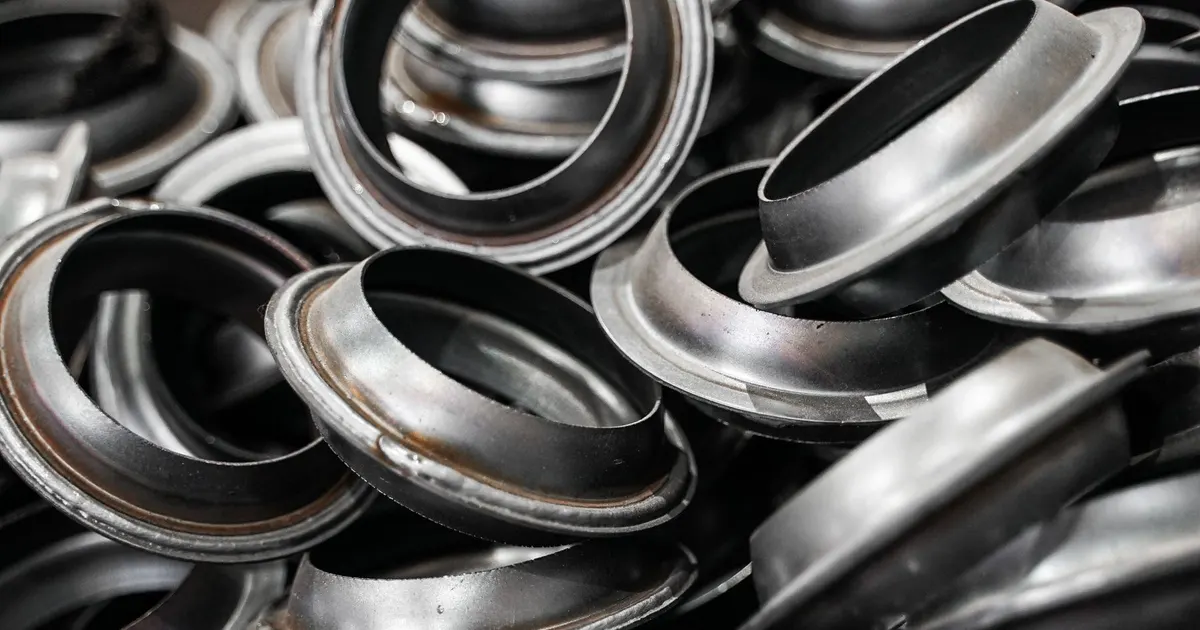
A conventional blanked edge is not smooth all the way through. Part of the thickness is sheared clean and part is torn, and the tear leaves a rough band and a burr. Fine blanking changes the process so that most or all of the edge is sheared clean. The part comes out flatter and the edge needs little or no secondary work. The price is a more complex press, more expensive tooling and a higher piece price, so the question for a buyer is when that edge earns its cost.
This guide compares the two on edge quality, tolerance, tooling and volume so you can decide before you write the RFQ.
What happens at the cut edge
When a punch pushes through sheet, the material first deforms, then shears, then fractures. The sheared band is the smooth, shiny part of the edge. The fracture band is the duller, rougher part below it. A small rounded corner on the entry side, called die roll, and a burr on the exit side complete the picture.
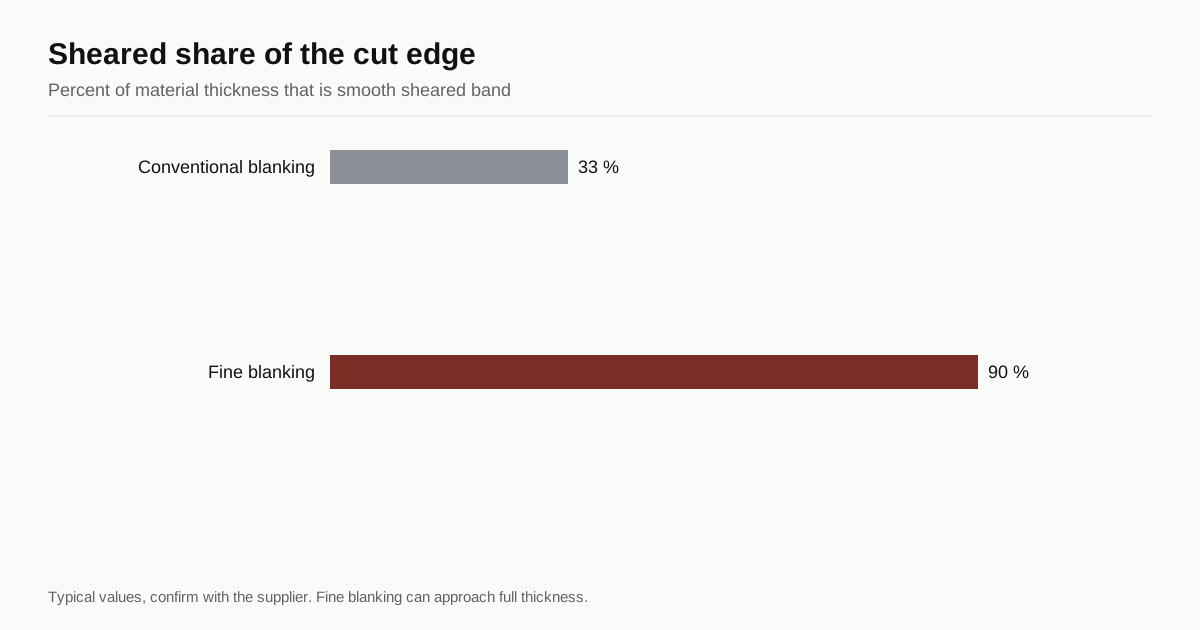
In conventional blanking the die clearance is a few percent of the thickness on each side, and the sheared band is typically about a third of the thickness, sometimes less. The rest of the edge is fracture. That is normal and acceptable for most stamped parts, because brackets, covers and clips do not need a smooth edge.
Fine blanking uses a very small clearance, often well below one percent of thickness per side. A raised ring on the pressure plate presses into the material around the cut and holds it from stretching sideways, while a counter punch under the part supports it as the main punch pushes down. Because the material is trapped, it shears instead of tearing, and the sheared band can approach the full thickness of the part.
The press and the tooling
Fine blanking needs a press with three independent forces: the main cutting force, the ring force that clamps the material and the counter force under the part. These are usually hydraulic or a mechanical-hydraulic combination, and the tool is built to close tolerances with a guided die set. A few things follow from that:
- The press costs more than a general-purpose mechanical press, so fewer shops have one.
- The tool is more complex, with a clamping ring, counter punch and close-fit guiding.
- Tool tryout takes longer.
- Strip is usually fed as coil or as pre-cut blanks for thicker work.
Many fine blanking tools are progressive, so a single press stroke can blank the part and also coin, form or emboss it. This lets the process make a finished part with several features in one hit, which is a large part of the value.
Edge quality and tolerance compared
| Feature | Conventional blanking | Fine blanking |
|---|---|---|
| Typical sheared share of edge | About one third of thickness | Up to nearly full thickness |
| Die clearance per side | Several percent of thickness | Well under 1 percent of thickness |
| Burr | Present, controlled by die condition | Small, often one side only |
| Typical flatness | Fair, parts can bow | Good, parts stay flat |
| Typical tolerance on features | Moderate, depends on thickness | Tighter, often a fraction of conventional |
| Minimum hole size relative to thickness | About 1 times thickness | Smaller, often about half thickness |
| Tooling cost | Lower | Higher |
| Piece price | Lower | Higher |
The figures are typical, and each shop publishes its own capability. If your print has a flatness or edge callout, ask each shop what it holds on similar parts.
When fine blanking pays
Fine blanking earns its cost when it replaces something else. A part with a smooth edge is usually otherwise made by blanking followed by shaving, grinding or machining. Fine blanking can remove those steps. Common cases include:
- Gears, ratchets and cams where the sheared edge works as a bearing or mating surface
- Parts with a functional edge, such as latch faces and sealing surfaces
- Thick, flat parts where a conventional blanked part would bow
- Parts with several features, such as a hole, a coined edge and a formed lip, made in one hit
- High volume parts where the saved secondary operations add up
It makes less sense for brackets and covers where nobody touches the edge, or for low volume parts where the tooling cost cannot be spread out.
Die roll, burr and flatness in practice
Three features of a blanked edge matter more than the sheared percentage alone. Die roll is the rounded shoulder on the entry side of the cut. In conventional blanking it can be a noticeable fraction of the thickness, and on a thin part it shows up as a soft edge. Burr is the sharp ridge on the exit side, and it grows as the punch and die wear. Flatness suffers because the sheared edge pulls the part slightly out of plane, so thick parts often bow after blanking.
Fine blanking reduces all three. The clamping ring holds the material flat, the small clearance leaves little room for a large burr to form and the counter punch keeps the finished part flat as it leaves the cut. A fine blanked part therefore often needs no flattening or deburring, which shows up in total cost even when the piece price is higher. Always ask what the shop does after the press. A conventional part that needs flattening, tumbling and a shaving step can end up costing more than a fine blanked part with none.
Where the money goes: a worked comparison
The numbers below are illustrative only and not a quote. Take a flat steel part, 6 mm thick, with a gear-type profile and one functional edge. Suppose the conventional route is blank, then shave, then deburr, with three operations and two handling steps. The fine blanking route is one press operation with a light tumble. The fine blanking tool costs several times more, but the route removes two operations and one setup per lot. At a few thousand pieces a year the extra tooling probably does not pay. At a few hundred thousand, the saved operations dominate and fine blanking is likely cheaper in total.
The breakeven depends on thickness, tolerance and secondary work. That is why the RFQ should state the functional edge and the volume, and ask for both routes.
Questions to ask a fine blanking shop
- Which press forces and part sizes does the press cover, and what is the maximum thickness?
- Which materials and conditions has the shop run, and does it supply the material or accept yours?
- What flatness and edge condition does it hold on parts like yours, and how does it measure them?
- Is the tool progressive, and which features can be made in the same hit?
- What happens to the tool between runs, and who owns it?
- What does the shop do after the press, and what does it send to outside processors?
A shop that answers with figures from parts it has actually run is easier to trust than one that quotes a brochure. Ask for a sample or a first-article report on a similar part.
Alternatives to consider
Before you commit, compare against three other routes:
- Conventional blanking with a shaving step. A second die shaves the edge smooth. This is a common middle route and costs less than fine blanking tooling.
- Conventional blanking plus machining. If only one surface needs to be smooth, machine only that surface. Read metal stamping vs CNC machining vs laser cutting for how the processes trade off.
- Laser or waterjet cutting. These give a clean edge with no tooling cost, but at a higher cost per part and with some heat effect on laser edges. They suit prototypes and low volume.
Each of these has a price at your volume. A fair RFQ asks for at least one alternative so you can see what the fine blanking premium buys.
Material and thickness limits
Fine blanking works best on ductile materials with a uniform structure. Low and medium carbon steels, many stainless grades, aluminum and copper alloys can all be fine blanked, though harder or less ductile materials crack more easily. Some steels are supplied in a special condition, often with a soft, spheroidized structure, to give a better sheared edge. Ask the shop what grade and condition it prefers, and whether it will certify the material.
Thickness range is wide, from thin gauge to about half an inch on larger presses. Very thin material can usually be done in a conventional die with tight clearance, so the real fine blanking advantage appears as thickness rises.
Cost drivers specific to fine blanking
On top of the usual stamping cost drivers, fine blanking adds:
- Tool steel and build time, because the tool is more complex than a plain blanking die
- Press time, since fine blanking presses run slower than high-speed mechanical presses
- Material grade, if the shop wants a special condition
- Secondary operations, such as deburring or heat treatment, which may still be needed
- Setup and tryout, longer than for a simple die
For general guidance on what moves price, see stamping tooling cost and die ownership. Remember that tooling ownership and storage terms apply to fine blanking tools the same way, so write them into the quote.
What to put on the RFQ
Give the shop what it needs to quote both routes:
- The print with edge and flatness callouts marked
- Material, grade and thickness
- Annual volume and order size
- Which edges are functional and which are not
- Any secondary operations you expect
- A note if you accept an alternative such as shaving
- The metal stamping RFQ checklist covers the remaining fields
Marking functional edges is the single most useful step. A shop that knows only two edges matter can price a cheaper tool than one that assumes every edge must be smooth.
Checklist before you choose fine blanking
- Decide which edges are functional.
- Check what the same part costs with a shaving or machining step.
- Confirm the thickness and size fit the shop’s press.
- Ask which material condition the shop wants.
- Compare tooling plus piece price over your expected volume.
- Ask for first-article inspection data on edge condition.
When the print is ready, send your RFQ and compare the quotes you get back within 24 business hours.
See also: the fineblanking reference: press forces, edge quality and materials.
Frequently asked questions
Is fine blanking the same as precision stamping?
No. Precision stamping is a broad term for tight-tolerance work in a conventional die. Fine blanking is a specific process that clamps the material and uses a very small die clearance, which gives a mostly smooth sheared edge. Many precision parts never need it.
What thickness can be fine blanked?
Fine blanking is common from thin gauge up to roughly 12 mm (0.5 inch), though each shop has its own press limits. Confirm the maximum thickness and part size with the shops you ask.
Can any steel be fine blanked?
Not equally well. Fine blanking works best with materials that have good ductility and a clean, uniform structure, such as low and medium carbon steels in a suitable condition. Ask the shop which grades it has run before and whether it wants a specific heat treat condition.
Need a quote for this part?
Send the print. We match you with up to 3 stamping shops and reply within 24 business hours.
Send my RFQ