Guides / Process
Stamping Die Maintenance: How Tool Life Is Managed and the Questions Worth Asking
November 4, 2026
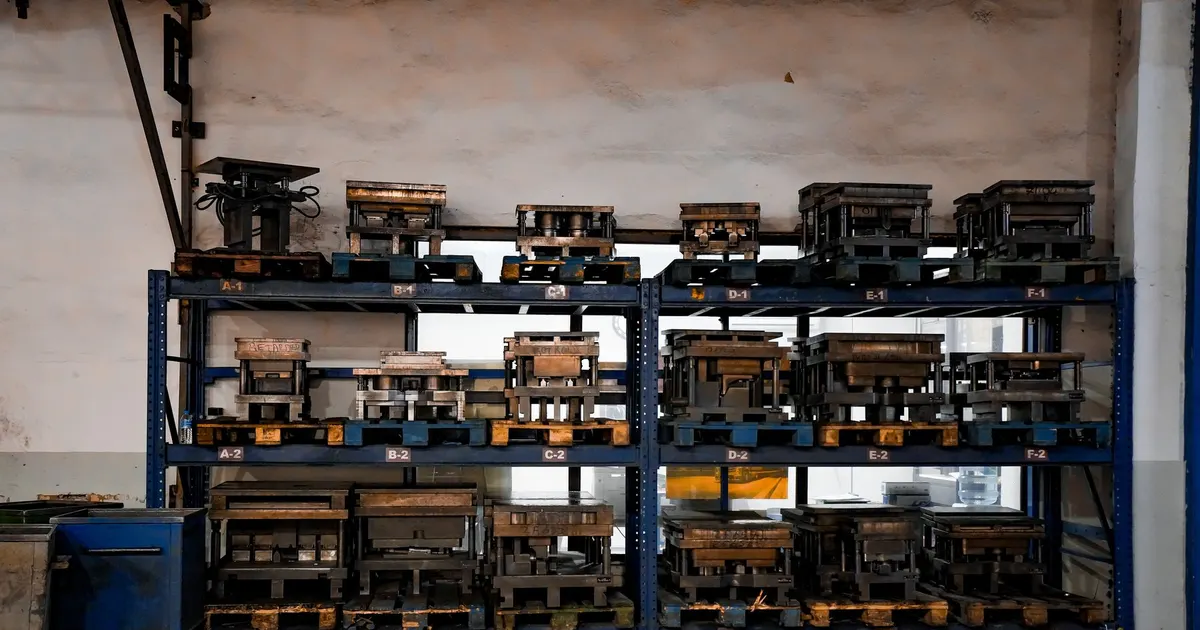
A stamping die is a long-lived asset, but it is not permanent. Every stroke rounds the cutting edges a little, springs lose force, guide bushings loosen and the strip wears the surfaces that it touches. Left alone, a die starts to make taller burrs, then parts out of tolerance, and eventually something breaks. A die that is maintained on a schedule keeps its output steady for millions of strokes.
Maintenance is a shop practice, not a line on the print, so buyers rarely see it until it fails. This guide explains how tool life works, what a good program looks like and which questions separate a shop that manages its dies from one that runs them until they fail.
What wears in a die
Cutting punches and die buttons take the heaviest wear. Each stroke rubs the cutting edge against the strip, and the edge radius grows. A larger radius needs more force to cut and leaves a taller burr. Forming and draw sections wear differently, with polish lost on draw radii and galling where material sticks to the tool.
Other parts need attention too:
- Springs and nitrogen cylinders that hold the strip or push it off the punch lose force with cycles.
- Guide pins and bushings wear and open up the alignment.
- Pilots wear at their tips and stop locating the strip accurately.
- Stripper plates wear at the punch openings and let the strip lift.
- Sensors and wiring fail from vibration and oil.
A maintenance plan covers all of these, not only the sharpening of punches.
Tool steels and tool life
The material of the cutting parts sets a large part of the tool life. Common choices are:
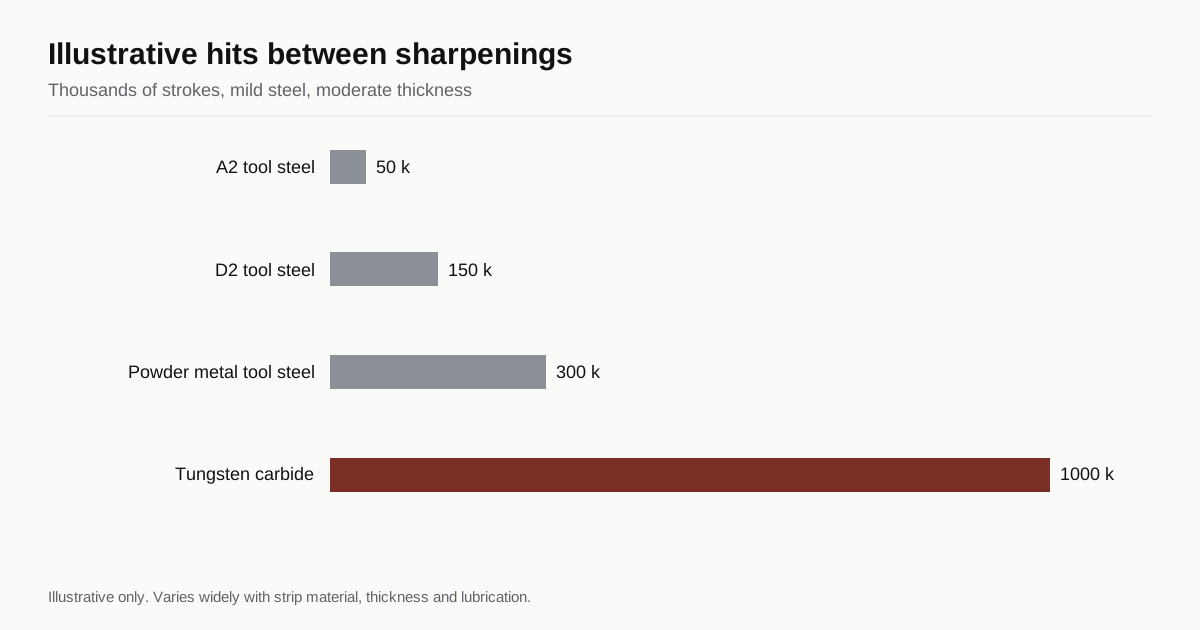
| Tool material | Typical use | Relative life between grinds | Relative cost |
|---|---|---|---|
| A2 tool steel | General blanking, light duty | Baseline | Low |
| D2 tool steel | Most progressive dies, steel and stainless | Longer | Moderate |
| Powder metallurgy tool steel | High volume, tougher work | Longer still | Higher |
| Tungsten carbide | Very high volume, thin or abrasive strip | Many times longer | Highest |
| Coatings such as titanium nitride | Added to reduce galling and wear | Extends the base steel | Added cost |
Strip material matters as much as tool material. Stainless steel work hardens and grinds down tools faster than mild steel. Electrical steel for laminations contains silicon and is abrasive, which is why carbide is common there. Aluminum tends to gall and pick up on the tool, so surface finish and lubrication matter more than raw hardness. See motor lamination stamping for an example where carbide is standard.
Typical sharpening intervals
There is no universal figure for how many hits a die runs between sharpenings. With D2 tooling on mild steel of moderate thickness, intervals in the range of one hundred thousand to a few hundred thousand strokes are common, while stainless or thicker material can cut that sharply. Carbide can run into the millions. Each grind removes a small layer, often a few thousandths of an inch, so a die has a finite number of grinds before the punches become too short and must be replaced.
When punches are ground shorter, the shop must also adjust the die, usually with shims under the punches or die buttons, to keep the shut height and the cut engagement correct. A shop that tracks how much length each punch has left can plan replacements before the die starts failing.
The right trigger for sharpening is not a fixed count alone. Good shops use a count as a reminder and a measurement, such as burr height, as the real test. The article on stamping burr height shows how the two connect.
What a maintenance program includes
A working program has these parts:
- Hit counting. A counter on the press or the die records strokes per run and in total.
- Inspection at the end of each run. The die is cleaned, checked for wear, chips and cracks and measured at key points.
- Scheduled sharpening and part replacement. Based on the count and on measured wear.
- Records. A die log with run dates, counts, repairs, replaced parts and who did the work.
- Spares. Common wear parts such as punches, buttons, springs and pilots are kept on hand so a repair does not wait on a supplier.
- Storage. Dies are cleaned, oiled and stored where they will not rust or get damaged.
- First-off checks after every setup. The first parts from a repaired die are measured against the print before the run continues.
Shops that run a small number of dies for many customers often keep a central tool crib and a dedicated maintenance team. Others rely on the setter. Either can work if the records are kept.
Maintenance is one stage of the die life in our guide to metal stamping tooling.
Questions to ask a shop
Use these during quoting and again at first article:
- Who maintains the die, and where is it stored between runs?
- Is there a die log, and can you see it?
- What triggers a sharpening, a count or a measurement?
- Which spares does the shop keep for this die?
- What happens if a punch breaks or the die crashes, and who pays?
- Does the quote include routine sharpening, or is it extra?
- What is the expected tool life, and does the shop warrant the tooling?
Pay attention to what the shop calls a tooling warranty. Some shops guarantee a number of parts, others guarantee the tool against defects for a period. Ask which one applies, and read what it excludes. The guide on stamping tooling cost and die ownership covers ownership and the paperwork.
When you own the die
Many buyers pay for the tooling and own it, while the shop keeps and runs it. That split creates a gap, because the shop uses the die but does not pay to replace it. Close the gap with terms that say:
- The shop maintains the die to an agreed standard and keeps the records.
- Routine sharpening and wear parts are paid by the shop, or by you at a stated rate.
- Major repair or replacement needs your written approval above a set amount.
- The die carries a tag with your name, and the shop insures it while it is in the building.
- You can ask for the die and its records at any time, and the shop releases it within a stated period.
The last point matters if you move production. A die that has been maintained transfers cleanly, because the next shop can read the log, see the wear state and order the spares. A die with no records is a risk, since nobody knows its history. Before shipping a die to a new shop, ask the current shop for a final inspection report with measurements of the main cutting parts, and ask the new shop to confirm the condition on arrival.
Planning for end of life
Every die wears out. The cutting parts get too short, cracks appear or the cost of repair rises above the cost of a new tool. For a long program, plan for this. Ask the shop for an estimate of remaining life and the lead time for a replacement die. For critical parts, some buyers pay for a second die before the first is worn, so production never stops. The cost is higher, but so is the cost of an empty line. Ask each shop how long a replacement die takes and what it needs from you to start.
What poor maintenance looks like on your parts
Buyers see the result in the parts before they see it in the die. Signs include:
- Burr height creeping up over a run or across repeat orders
- Dimensions drifting, especially hole position and flatness
- Scratches or galling marks on formed surfaces
- Occasional missing features from a broken punch
- Frequent unplanned stops and late shipments
If you see these, ask for the die log and the corrective actions. Related defects appear in common metal stamping defects.
Maintenance and cost
Maintenance costs money, and it appears in the piece price in one of three ways. Some shops include a standard allowance for sharpening in the price. Others charge per grind. A few quote a tool life and charge for refurbishment after that. None of these is wrong, but the terms differ, and a low piece price may exclude a large maintenance bill. When you compare quotes, ask each shop what the price includes. The same question belongs in how to read a metal stamping quote.
For long programs, consider asking for a planned refurbishment at a set hit count, with the cost agreed in advance. That turns a surprise into a budget line.
What to put on the RFQ
Add maintenance expectations to the RFQ so shops quote on the same basis:
- Annual volume and total program volume
- Expected tool life in parts, if you have a target
- Burr and dimension limits that the maintenance must hold
- Whether you want a die log and hit count reports
- Who owns the tool and where it is stored
- Whether routine sharpening is included in the piece price
The metal stamping RFQ checklist lists the other fields.
Checklist before you award
- Ask to see a die log from a similar tool.
- Confirm the trigger for sharpening.
- Confirm which spares are stocked.
- Agree on who pays for routine and major repairs.
- Agree on storage and ownership in writing.
- Set limits for burr and key dimensions that maintenance must hold.
When the print is ready, send the RFQ and compare how shops answer these points, with replies within 24 business hours.
See also: the stamping die specification checklist.
Frequently asked questions
How many parts can a stamping die make?
It depends on the tool steel, the material being cut and the maintenance. A well-built hardened progressive die with scheduled sharpening can make millions of parts over its life. Dies for abrasive or high-strength material wear faster, and carbide tooling lasts much longer between grinds.
Who pays for die maintenance?
The terms vary and should be in writing. Many shops include routine sharpening in the piece price and quote major repairs separately. Ask what counts as routine and what does not, and whether a repair needs your approval.
How do I know a die is being maintained?
Ask for the die log. It should show the hit count, the sharpening dates, parts replaced and repairs made. A shop that keeps these records can answer most questions in minutes.
Need a quote for this part?
Send the print. We match you with up to 3 stamping shops and reply within 24 business hours.
Send my RFQ