Guides / Process
Stamping Press Tonnage Calculation: The Formula Shops Use and Where It Falls Short
November 5, 2026
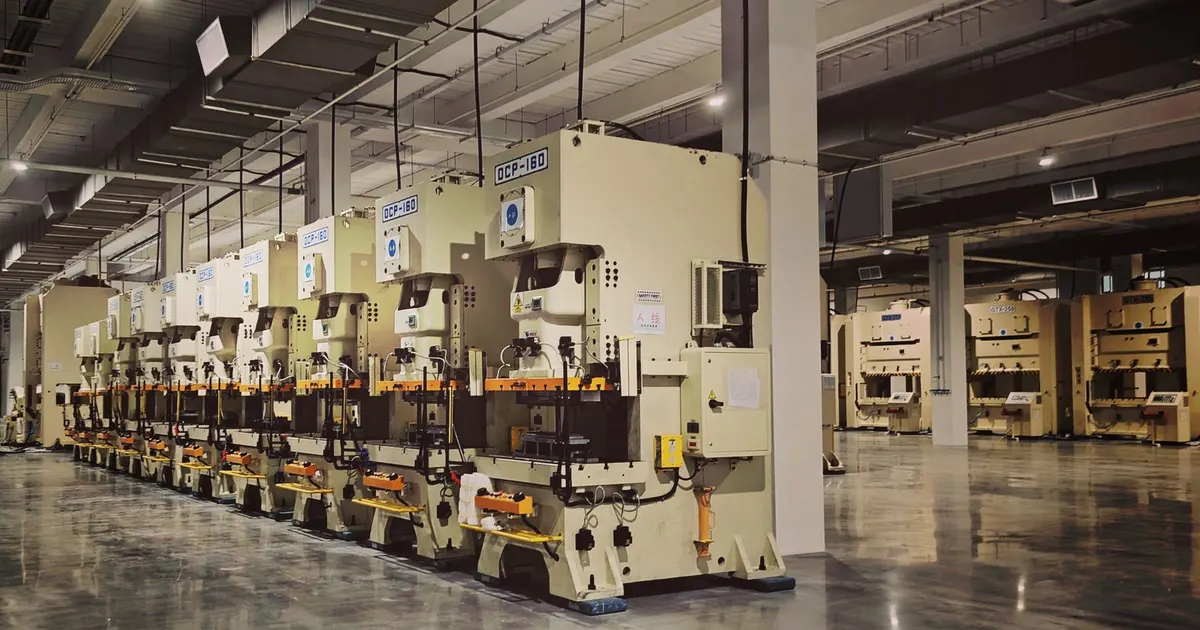
A press is rated in tons, and every stamping job needs a press that can deliver more force than the part demands. Pick a press that is too small and the machine stalls, the tool breaks or the press wears out early. Pick one that is far too large and the part carries the hourly rate of a machine it does not need. Shops estimate required force with a short formula, then add margins for everything the formula leaves out.
This guide shows that formula, a worked example, typical material values and the extra loads that catch people out. You do not need to run the numbers as a buyer, but knowing how a shop sizes a press explains why two quotes for the same part can name two different machines.
The basic cutting force formula
Blanking and piercing force comes from the area of material that must shear. That area is the cut perimeter multiplied by the thickness. The force is that area multiplied by the shear strength of the material:
Force = perimeter x thickness x shear strength
Use consistent units. In US units, perimeter and thickness in inches and shear strength in psi give force in pounds. Divide by 2,000 for US tons. Shear strength is not always on a data sheet. A common shortcut is to take shear strength as about 75 to 80 percent of the tensile strength of the material.
Perimeter means every cut in the same stroke. A part with a blanked outline and four pierced holes cuts all five perimeters in one hit, so add them together.
A worked example
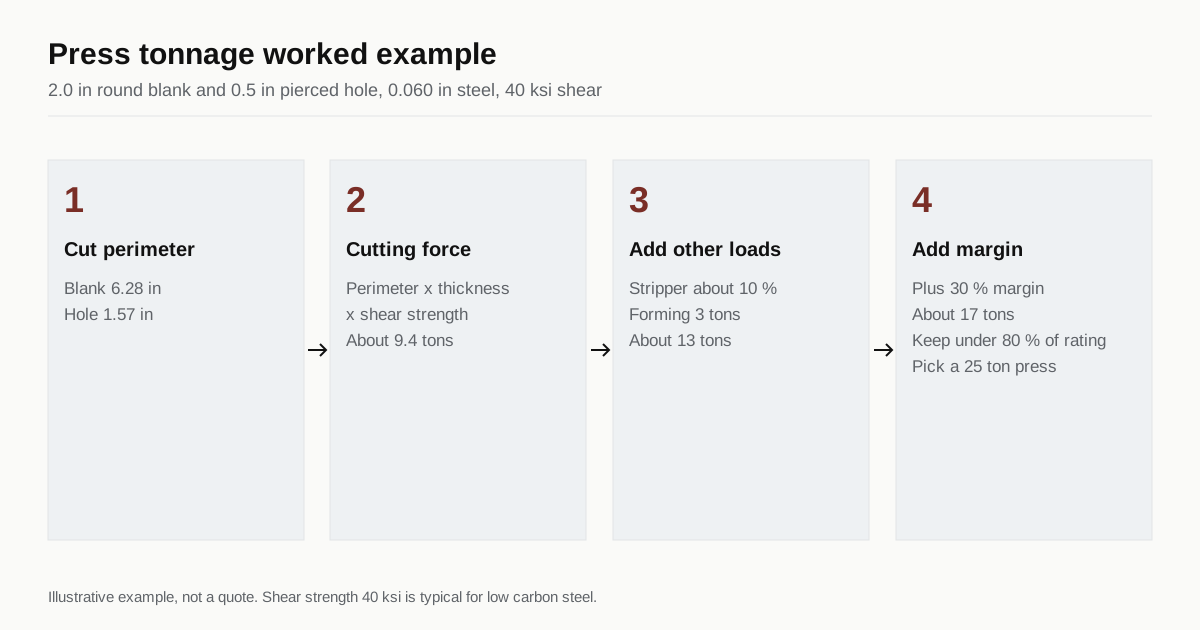
Take a round steel blank 2.0 inches in diameter, 0.060 inch thick, with one 0.5 inch hole pierced in the center. Use a shear strength of 40,000 psi, which is in the typical range for low carbon cold rolled steel.
- Blank perimeter: 3.1416 x 2.0 = 6.28 inches
- Blanking force: 6.28 x 0.060 x 40,000 = about 15,100 lb, or 7.5 tons
- Hole perimeter: 3.1416 x 0.5 = 1.57 inches
- Piercing force: 1.57 x 0.060 x 40,000 = about 3,800 lb, or 1.9 tons
- Total cutting force: about 9.4 tons
That is only the cutting load. The shop then adds the stripper force that pulls the strip off the punches, often around 10 percent of the cutting force, and any forming load. If this part also had a form that needs 3 tons, the total reaches about 13 tons. A common practice is to add a margin of 20 to 30 percent, which brings the figure near 17 tons. If the shop wants the working load to stay at or below about 80 percent of rating, it needs a press rated near 21 tons or more, so a 25 ton press is the practical choice.
These percentages vary by shop and press, and the example is only an illustration. It shows the order of calculation, not a quote.
Typical shear strength by material
| Material | Typical shear strength (ksi) | Effect on force |
|---|---|---|
| Aluminum 3003, half hard | 14 to 15 | Low |
| Aluminum 5052, H32 | 18 to 20 | Low |
| Copper, half hard | 25 to 30 | Moderate |
| Brass, half hard | 30 to 45 | Moderate |
| Cold rolled steel, low carbon | 35 to 50 | Moderate |
| Stainless 304, annealed | 60 to 70 | High |
| Stainless 301, full hard | 100 and above | Very high |
These are typical ranges. Strength rises with temper and cold work, so a harder temper of the same alloy needs more tonnage. Check the material certificate for the lot, not only the alloy name.
Loads the formula does not include
The cutting formula is a starting point. Real stamping adds several other loads, and a shop adds them one by one:
- Stripper and pad force. Springs or nitrogen cylinders hold the strip flat and push it off the punch. Their force adds to the press load during the stroke.
- Forming and bending force. Bends, ribs and embosses add load in the lower part of the stroke, where the press is working hardest.
- Drawing force. Deep draws need force through a long stroke. A rough estimate uses the punch perimeter, thickness and tensile strength with a factor of roughly 0.6 to 0.7, and the blank holder force comes on top. See deep drawn parts design rules.
- Coining. Coining squeezes the material to flow it, and the pressures are far above those of simple cutting. Shops check it separately.
- Reverse load. When the punch breaks through the strip, the stored energy releases and the press snaps back. This shock is called snap-through or reverse tonnage, and tools and presses are rated for it too.
In a progressive die, add the loads of all stations that act at the same time, since every station fires on every stroke.
Tonnage is not the whole story
Press tonnage is the force at one point. Three other factors decide whether a press is suitable:
- Rated tonnage point. A mechanical press delivers full rated force only near the bottom of the stroke, often within a few millimeters. Higher in the stroke, the available force is lower. A forming operation that needs force high in the stroke may need a larger press than the formula suggests.
- Energy. Drawing and heavy forming need energy through the stroke, not only peak force. A flywheel slows as it works, so a part that fits within tonnage can still stall the press.
- Load position. Force that acts far from the center of the bed tilts the slide and wears the gibs. Shops try to center the combined load of the die, and they check the center of pressure as part of die design.
Bed size, shut height and stroke length complete the check. A part can pass every tonnage test and still not fit the bed.
Press types and how the rating differs
Not every press delivers its rating the same way. A mechanical press stores energy in a flywheel and drives the slide with a crank or eccentric. It is fast and well suited to blanking and progressive work, but its full force is available only near the bottom of the stroke. A hydraulic press can deliver its full rated force at any point in the stroke and hold it, which suits deep drawing and long forming strokes, though it runs slower. A servo press drives the slide with a motor and can deliver high force across much of the stroke while letting the shop program speed and dwell. The article on servo press vs mechanical press covers that trade in more detail.
Frame style also matters. A gap-frame press has an open front that makes the die easy to reach, but the frame flexes under load, so it suits lighter work. A straight-side press has a stiffer frame with columns on both sides, which holds tighter parallelism and suits heavier and more precise work. When two shops quote the same part on different frame types, the difference often shows up in the price and in the tolerance each can hold.
Ways to lower the force
If the calculation points to a large press, there are ways to cut the load:
- Shear angle. Grinding a small angle on the punch or die face spreads the cut over a longer part of the stroke, which can lower peak force by roughly a quarter to a third at the price of some distortion.
- Staggered punches. Making some punches a little longer than others cuts them in sequence instead of at once.
- Smaller cut perimeter. Fewer or smaller holes, or a tighter nesting of the blank, lower the total perimeter.
- Thinner or softer material. Where the design allows, a lower strength temper reduces force directly.
Each change has a cost in tool complexity or part quality, and the shop weighs them against the price of a bigger press. The stamping tooling cost and die ownership guide covers how tool design changes feed into price.
Why this matters on the quote
The press a shop chooses sets the hourly rate in the piece price. A 60 ton press and a 400 ton press have very different running costs, and a shop that quotes the smaller one for a part that needs the larger one will either miss on cost or fail on the floor. Two quotes with very different piece prices may simply assume different presses. When quotes differ, ask each shop which press it plans to use and why. The guide on reading a metal stamping quote lists other items worth comparing.
What to put on the RFQ
Give the shop what it needs to size the press:
- Material, alloy, temper and thickness
- Part outline size and the hole sizes
- Any forms, draws or coining features
- Annual volume and expected lot size
- Whether you accept a different press than the one used for a past order
Shops size the press from the print and the volume, so a clear drawing saves a round of questions. The metal stamping RFQ checklist lists the other fields.
Checklist for sizing a press
- Add up every cut perimeter for the stations that fire together.
- Multiply by thickness and shear strength.
- Add stripper, forming and drawing loads.
- Add a margin and keep the working load under the press rating.
- Check energy, rated tonnage point and load center.
- Confirm bed size and shut height.
When the part is ready, send the RFQ and compare how each shop sizes it, with replies within 24 business hours.
See also: the stamping press tonnage calculator.
Frequently asked questions
Is the press tonnage the same as the force a part needs?
No. The part needs a certain peak force, and the press has a rated capacity. Shops pick a press whose rating is comfortably above the calculated load, often keeping the working load well under the rated figure, and they also check energy and where the load sits on the bed.
Does a thicker part always need a bigger press?
Thickness raises cutting force in direct proportion, so yes for blanking and piercing, all else equal. But perimeter and material strength matter just as much. A thin part with a very long cut line can need more force than a thick small part.
Can I choose the press as a buyer?
Usually the shop chooses, because it knows the presses on its floor and how each runs. As a buyer, you help most by stating material, thickness, part size and annual volume so the shop can match the part to the right machine.
Need a quote for this part?
Send the print. We match you with up to 3 stamping shops and reply within 24 business hours.
Send my RFQ