Guides / Process
Fourslide and Multislide Stamping: Which Parts It Makes Cheaper Than a Progressive Die
October 27, 2026
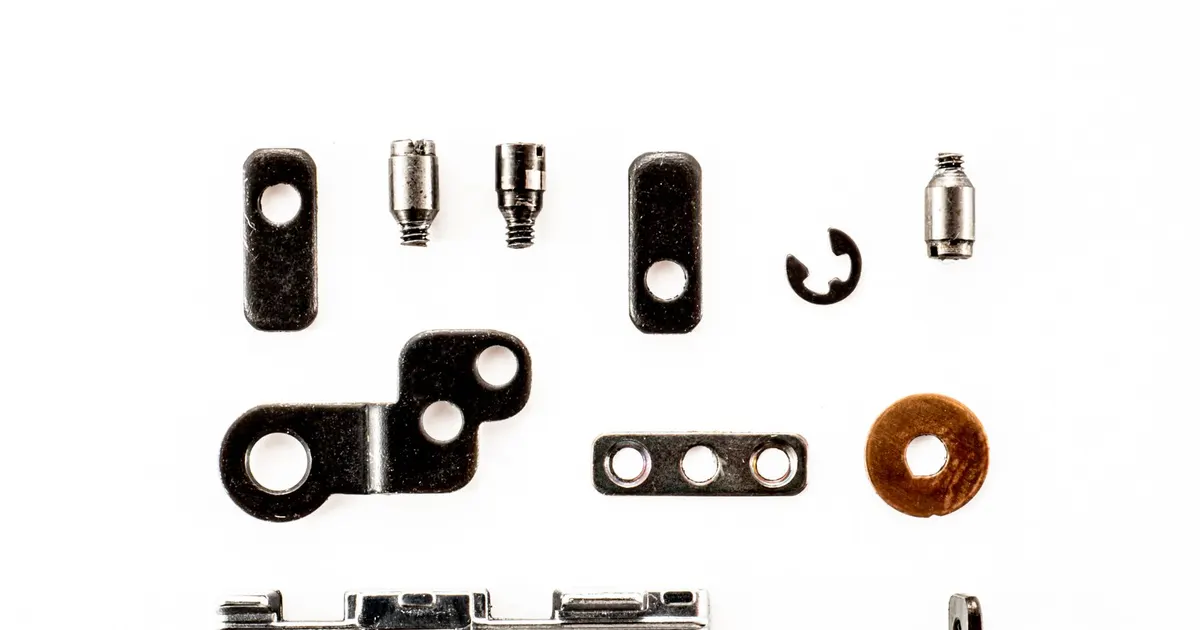
A fourslide machine bends a part instead of punching it. Strip or wire feeds into a work area, and four tool slides, each driven by its own cam, move in from different sides to cut, bend and form the part one motion at a time. Multislide machines add a vertical press ram and more stations to the same idea. For small parts with several bends in different directions, this often costs less than a progressive die and gives the buyer a lower tooling bill.
This guide covers which parts fit, where the process stops being a good idea and what to put on an RFQ so shops can quote both routes. For the full comparison of die types, read progressive die vs transfer die vs deep draw first.
How a fourslide machine works
The strip comes off a coil, straightens and feeds to a fixed length. A cutoff tool shears the blank, and the slides then fold it around a center form. Each slide carries a simple tool and moves on its own cam, so the shop can time a bend, a hold and a second bend in any order. A part can be curled, hooked, folded back on itself and twisted in one cycle.
Multislide machines work the same way but add a press ram above the work area. That ram can pierce, emboss or coin while the slides form, so a multislide part can combine a few punched features with its bends.
Tooling for both is built from small hardened tool blocks that mount on the slides. Changing from one part to another means swapping those blocks and re-timing the cams, which is faster and cheaper than building a new die set.
Parts that suit fourslide
Fourslide is a good match when most of the part’s value sits in its bends:
- Spring clips, retaining clips and battery contacts with several bends
- Electrical terminals and connector contacts
- Wire forms and flat springs
- Brackets and hooks with compound bends
- Small formed parts that a progressive die would need many form stations to make
The strip is usually thin. Standard fourslide machines run material from very thin foil up to roughly 1.5 mm (0.060 inch). Multislide machines take heavier strip. Strip width and finished part size stay small, typically a few inches at most, because the tool slides work in a compact area.
Material choice is wide: carbon steel, stainless, brass, phosphor bronze and other copper alloys. Spring tempers are common because fourslide tooling forms them without the stretching a draw die applies. Always check the minimum bend radius for the temper you specify. Hard tempers crack at tight bends, and the cam-driven motion does not fix that.
Parts that do not
The process has real limits:
- Flat parts with many pierced holes and tight hole spacing belong in a progressive die.
- Deep drawn shapes need a press and draw tooling. See deep drawn parts design rules.
- Large parts exceed the work area of the machine.
- Very high volumes of simple parts usually run cheaper in a die at several hundred strokes per minute.
- Parts needing very flat surfaces or tight flatness over a long length suit a press better than a bent-up form.
A useful test: count the bends and the punched features. Many bends in many directions with few holes points to fourslide. Many holes and only one or two bends points to a progressive die.
Material and temper choices
Because the slides form by bending and folding, fourslide suits materials that other processes find awkward. Hard spring tempers of carbon steel, stainless steel and phosphor bronze are routine. A progressive die can form them too, but its forming stations often stretch the strip, and a hard temper may crack there. A cam-driven slide wraps the strip around a form with less stretch.
The rule that still applies is the bend radius. Each alloy and temper has a minimum radius, often given as a multiple of thickness, and it grows as the material gets harder. Bends made across the rolling direction of the strip tolerate tighter radii than bends made along it. If your clip has bends in several directions, tell the shop which direction is the springy one, because that bend carries the load and deserves the best grain orientation. The article on stamped spring clips goes deeper on this.
Secondary operations on fourslide parts
Many fourslide parts leave the machine finished, which is part of the cost advantage. When they need more, the usual extras are:
- Plating or coating after forming, or pre-plated strip fed into the machine
- Heat treatment of carbon steel parts after forming, then tempering
- Tumbling to break sharp edges
- Welding or assembly with a second component
Heat treating after forming brings distortion risk, because a thin bent part moves when it quenches. Pre-hardened strip avoids this but limits how tight the bends can be. Raise the choice early so the shop quotes the route you actually want. More on this in secondary operations after stamping.
A simple cost comparison
Suppose a small terminal needs five bends and one pierced hole. A progressive die for it needs blanking, piercing and several form stations, so the die has many parts and a long build. A fourslide setup needs a few tool blocks and a cam timing plan. At 50,000 pieces per year the fourslide route may carry the lower total cost because tooling is a larger share of the total. At several million pieces per year the die’s faster stroke rate and lower labor per piece can win. The crossover moves with the part, so do not rely on a rule of thumb. Ask both questions in the same RFQ and compare tooling plus piece price over your expected volume.
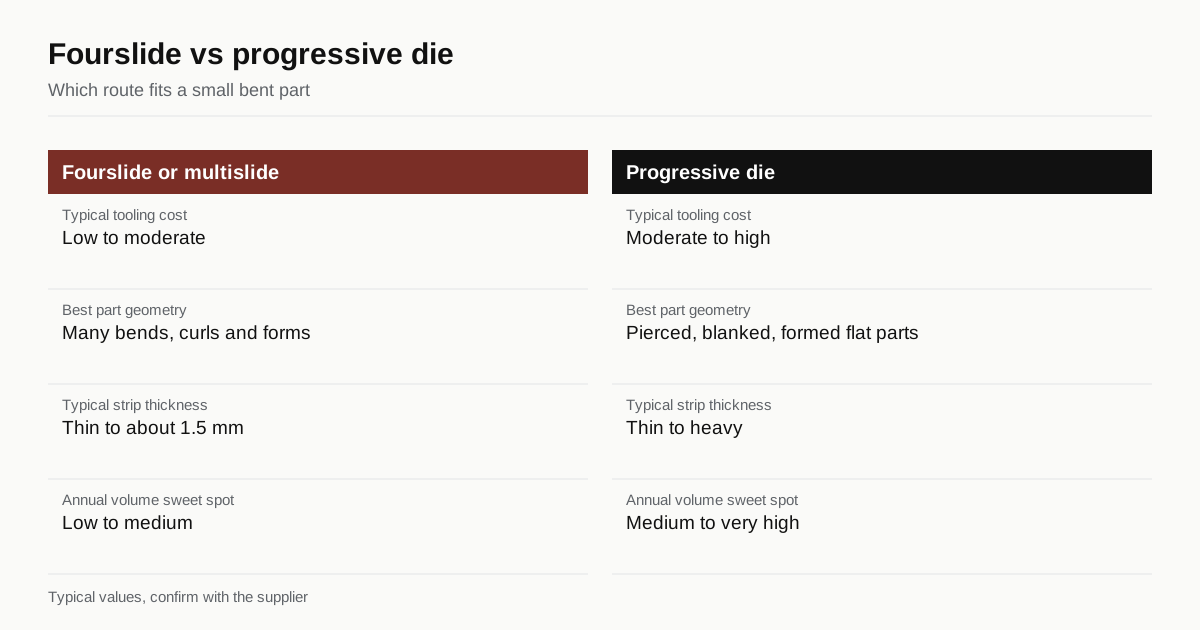
Fourslide vs progressive die
| Factor | Fourslide or multislide | Progressive die |
|---|---|---|
| Typical tooling cost | Low to moderate | Moderate to high |
| Tooling lead time | Often a few weeks | Often several weeks to months |
| Best part geometry | Many bends, curls and forms | Pierced, blanked and formed flat parts |
| Typical strip thickness | Thin to about 1.5 mm (multislide heavier) | Thin to heavy |
| Typical speed | Moderate | High |
| Design changes | Easier, tool blocks swap | Harder, die steel changes |
| Annual volume sweet spot | Low to medium | Medium to very high |
These are typical ranges and each shop quotes its own. A part made on one route today can move to the other as volume grows, so ask for both.
Tooling and setup
Fourslide tooling is usually lower in cost because the tools are small and the machine supplies the motion. A progressive die contains every station in one hardened set, and the shop prices that steel, the toolmaker’s hours and the tryout. With fourslide, the shop builds a few tool blocks and sets cam timing, so a new part often reaches production sooner.
Setup still takes skill. Timing the slides, checking spring-back and holding a bend angle within tolerance are done by a setter, not by a fixed die. Ask the shop how it records setup parameters so a repeat order matches the first one. For more on ownership and storage, read about stamping tooling cost and die ownership.
Tolerances to expect
Bend angles on fourslide parts are typically held within a degree or two on a stable process, and tighter angles need a dedicated check fixture. Overall dimensions between bends depend on strip thickness variation, spring-back and tool wear. Parts with several bends accumulate tolerance, so dimension the functional features and let the shop propose the rest.
If a part has a critical relationship between two bent features, say so on the print. A shop can then add an inspection step or change the forming order. The page on metal stamping tolerances and what costs extra lists which callouts raise the price.
Quality checks that fit the process
Inspection on bent parts differs from inspection on flat blanked parts. A flat part is measured with calipers and a vision system. A fourslide part has angles, heights and spring-back that need gauges. Ask the shop how it checks:
- Bend angle with a go/no-go gauge or an optical comparator
- Overall height and width with a fixture, since calipers can distort a springy part
- Free-state shape after forming, because spring-back changes once the tool releases
- Burr direction, which is set by how the cutoff tool meets the strip
First-article reports from the setter and periodic checks during the run are normal. For parts that act as springs, a force test at a set deflection is often more meaningful than any dimension. If force matters on your part, put the force and the deflection on the print, and let the shop adjust tool timing to meet it.
What to put on the RFQ
Shops can only quote fourslide against a progressive die if the RFQ gives them what they need:
- The print, with the flat pattern if you have it
- Material, temper and thickness
- Annual volume and expected order size
- Critical dimensions and bend angles
- Surface finish or plating requirement
- Whether holes need tapping or other secondary work
- A note that you accept either process, if you do
Ask for two quotes in one response, one for fourslide or multislide and one for a progressive die, each with tooling cost, piece price and lead time. That makes the comparison direct. The full list of fields is in the metal stamping RFQ checklist.
Checklist before you choose
- Count bends and punched features on the print.
- Check that thickness and size fit a fourslide work area.
- Confirm the temper allows your minimum bend radius.
- Estimate annual volume and a likely growth path.
- Ask for tooling and piece price on both routes.
- Ask who owns the tooling and how setups are recorded.
When the part is ready, send the RFQ and the print goes to up to 3 stamping shops, with replies within 24 business hours.
Frequently asked questions
What is the difference between fourslide and multislide?
Both feed strip or wire into a work area where several tool slides move in from different directions, driven by cams. Fourslide machines usually have four slides and suit lighter material. Multislide machines add a vertical press ram and extra stations, so they handle heavier strip and more operations in one pass.
Can a fourslide machine make a part with a lot of holes?
It can pierce a few holes, but a progressive die is usually the better choice when a part needs many pierced features or tight hole-to-hole position. Fourslide earns its place on parts defined by bends and forms, not by piercing.
How many parts do I need before fourslide tooling pays off?
There is no single number. Fourslide tooling is often a fraction of progressive die cost, so it can pay off at lower volumes. Ask each shop to quote both routes with tooling and piece price side by side.
Need a quote for this part?
Send the print. We match you with up to 3 stamping shops and reply within 24 business hours.
Send my RFQ