Guides / Process
Servo Press Stamping vs Mechanical Press: Which Parts Gain From Programmable Motion
October 31, 2026
Most stamping presses used for decades are mechanical. A motor spins a flywheel, a clutch connects the flywheel to a crankshaft and the crank drives the slide up and down in a fixed pattern. The slide moves fast through the stroke and slows naturally near the bottom, and a shop can change the speed of the whole press, but not the shape of the motion.
A servo press replaces that fixed motion with a programmable one. A large servo motor drives the slide through a crank or linkage, and the controller decides how fast the slide moves at every point of the stroke. That ability changes what some parts can do in a die, and it comes with trade-offs in cost and speed.
How the two presses move
On a mechanical press, the slide follows a curve set by the crank. It approaches the strip fast, hits it at a speed set by the stroke rate and then stops for an instant at the bottom before returning. The speed at contact is the same for every part.
On a servo press, the shop can write the motion. It can approach quickly, slow down just before the die touches the strip, form at a controlled speed, pause at the bottom of the stroke and return fast. It can also shorten the stroke for a short part, which reduces the distance the slide travels and lifts the strokes per minute. Some servo presses run a pendulum motion, where the slide moves back and forth over only part of the stroke to save time.
Where servo motion helps
Controlled motion matters most when the metal is hard to form:
- Deep drawing. A slower, steady draw speed lets material flow, which cuts splits and wrinkles. A dwell at the bottom helps set the shape.
- High-strength steels and stainless. These materials spring back and crack more than mild steel. Slow forming and a pause at the bottom can improve shape and reduce rebound.
- Coining and embossing. Holding pressure at the bottom of the stroke flows the metal into fine detail.
- Thin and delicate parts. A slower approach reduces the impact that can distort a thin foil or a delicate feature.
- In-die tapping and assembly. The slide can slow down or pause while a tapping unit or an insertion head works. See in-die tapping and die sensors.
A second benefit is shock. A mechanical press delivers a sudden release when the punch breaks through the strip, a snap that sends vibration through the frame and tool. A servo can slow the slide through the breakthrough, which lowers noise and shock and can extend tool life.
Where mechanical wins
Servo is not a universal upgrade. Mechanical presses stay strong where:
- Speed matters. High-speed progressive stamping of small, thin parts runs at very high strokes per minute on dedicated mechanical presses. Servo presses can match some of those rates with short strokes, but at full stroke they are usually slower.
- Parts are simple. A flat blank or a shallow form has little to gain from controlled motion.
- Cost drives the decision. Mechanical presses cost less to buy and have lower hourly rates, which shows in the piece price at high volume.
- Maintenance is simpler. A mechanical press has fewer electronic components, although the clutch and brake wear and need service.
- Tonnage is very high. Large mechanical presses reach tonnages that servo drives do not yet match economically.
A shop with both press types can place each job where it runs best, which is why the shop, not the buyer, should choose.
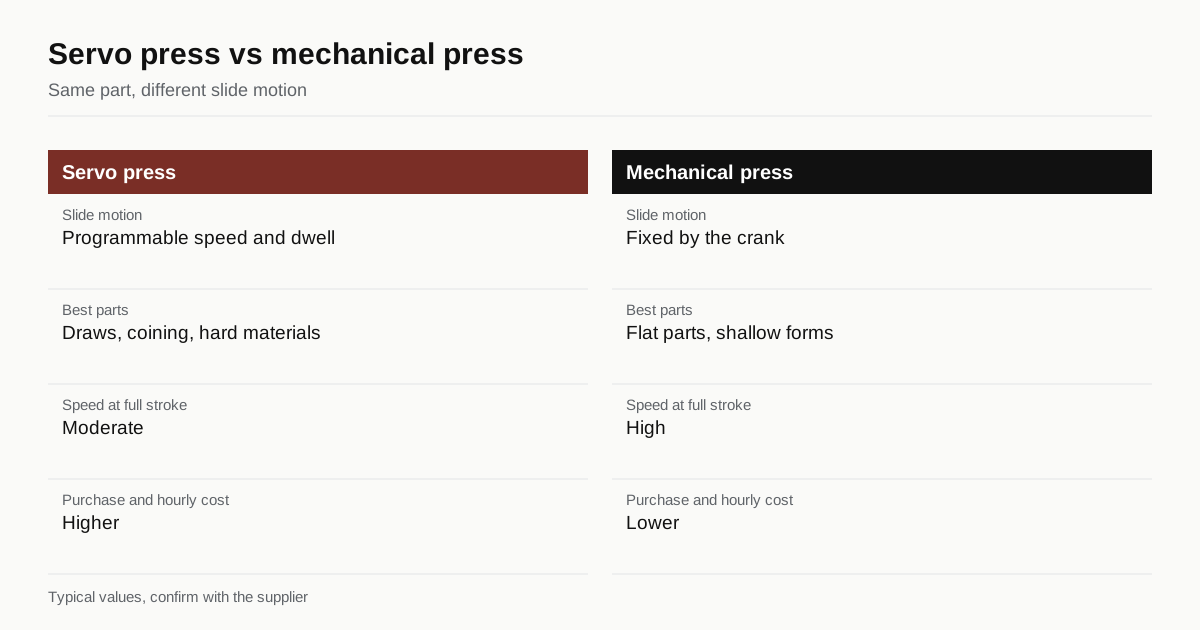
Servo vs mechanical at a glance
| Factor | Servo press | Mechanical press |
|---|---|---|
| Slide motion | Programmable | Fixed by crank |
| Speed at full stroke | Moderate | High |
| Speed with short strokes | Can rise | Limited by flywheel and crank |
| Dwell at bottom | Yes, adjustable | Only a brief pause |
| Shock and noise | Lower | Higher |
| Best parts | Draws, coining, hard materials, delicate parts | Flat parts, shallow forms, high volume blanking |
| Typical purchase cost | Higher | Lower |
| Typical hourly rate | Often higher | Often lower |
| Maintenance | Servo drive and electronics | Clutch and brake |
These are typical comparisons. Specific machines differ, so ask for the details of the press a shop plans to use.
Cost and piece price
The press changes the piece price in two ways: the hourly rate and the number of parts per hour. A servo press usually costs more per hour. If controlled motion lets a hard part run without scrap, or without a second operation, the higher rate can still give a lower price per good part. If the part is simple and a mechanical press runs it twice as fast, the servo is more expensive for no benefit.
Scrap and tool life enter the picture too. A part that cracks in 5 percent of strokes on a mechanical press can cost far more than the hourly difference. Ask the shop about scrap rates on similar parts and what it expects here. The page about how to read a metal stamping quote covers other items that move price.
An example: a drawn stainless cup
Consider a small cup drawn from stainless steel strip. On a mechanical press, the punch meets the blank at the full slide speed for that stroke rate. Stainless work hardens quickly, so the fast draw stretches the wall near the punch radius, and a share of cups split or thin out. The shop reduces the stroke rate to cope, which lowers output, or adds a second draw with an anneal between.
On a servo press, the shop programs a slower draw speed through the part of the stroke where the material flows, then returns to a faster speed for the rest. The wall stays more even, fewer cups split and the shop may remove a redraw. The press runs at a lower average rate than the mechanical one, but the good-part rate can be higher. That is the pattern to look for in any quote, since the price per good part is what matters. For the forming rules behind such parts, read deep drawn parts design rules.
Energy use, noise and floor conditions
Servo presses draw power mainly while the slide moves, and they can recover some energy on the way down. A mechanical press keeps a flywheel spinning all day, and that idle energy is a cost. Shops sometimes cite energy savings as a reason for servo, though the figure depends on duty cycle and utilization. Noise is usually lower on a servo press because the breakthrough shock is softened. For a buyer these points matter less than part quality, but they affect the shop’s operating cost and, over time, its price.
Availability matters too. A shop may own few servo presses and run them at high utilization. Asking for a servo slot may mean waiting, so state your lead time needs early. A shop that has to place your job on a servo press will quote a different hourly rate than the rate on its mechanical presses. Ask how the shop handles the capacity, and whether it can move the job to a mechanical press if the servo is busy.
Press type and tolerance
Because the servo controls motion at the bottom of the stroke, some shops find they hold tighter flatness and thickness in coined features. The slide position at the bottom is repeatable, and the dwell lets the metal settle. A mechanical press can do similar work if the die is built for it, but it relies on tool accuracy and thermal stability instead of programmed motion. Neither press removes the need for a good die. Read metal stamping tolerances and what costs extra for how tolerance callouts raise the cost.
How to know if your part needs servo
Look for these signs:
- The part is deep drawn or has a tall form relative to its width.
- The material is stainless, a high-strength steel or a hard temper.
- The part cracks or springs back on trial runs from other shops.
- The print has coined or embossed detail with tight depth tolerance.
- The part is thin and delicate, with features that distort under impact.
- A secondary operation could be moved into the die with slide dwell.
If none apply, a mechanical press is likely to do the job at lower cost. If several apply, ask each shop how it would run the part. The comparison of progressive die, transfer die and deep draw helps you see where press motion matters most.
What to put on the RFQ
Rather than naming a press, describe the challenge:
- Material, temper and thickness
- Part geometry, including draw depth and tight features
- Past problems, such as cracking, wrinkling or springback
- Annual volume and run size
- Tolerances on formed and coined features
- Whether you will accept a different process if it reduces cost
Ask each shop to state the press type it plans to use, the stroke rate and the expected scrap. The metal stamping RFQ checklist covers the remaining fields.
Checklist before you choose
- Identify whether the part has a forming challenge.
- Do not specify the press, but describe the challenge.
- Ask which press each shop will use and why.
- Compare strokes per minute and expected scrap.
- Compare the price per good part, not only the hourly rate.
- Ask for samples or first-article data from a similar job.
When you have the print ready, send the RFQ and compare the replies you receive within 24 business hours.
See also: the stamping press tonnage calculator.
Frequently asked questions
Is a servo press always better than a mechanical press?
No. A servo press gives control over slide motion, which helps forming, drawing and coining. For simple, high-speed blanking, a mechanical press often runs faster and costs less per hour. The better press depends on the part.
Do servo presses make better parts?
For parts that need controlled forming, often yes, because slowing the slide at contact and holding at the bottom can reduce cracking, springback and tool wear. For plain flat parts, the difference is small.
Should I specify a servo press on the RFQ?
Usually not. Describe the part and the forming challenge, and let the shop choose the press. If you suspect the part needs controlled motion, ask the shop to say which press it would use and why.
Need a quote for this part?
Send the print. We match you with up to 3 stamping shops and reply within 24 business hours.
Send my RFQ