Guides / Process
Automotive Stamping Brackets: Matching Volume, Material and Die Type to the Part
October 20, 2026
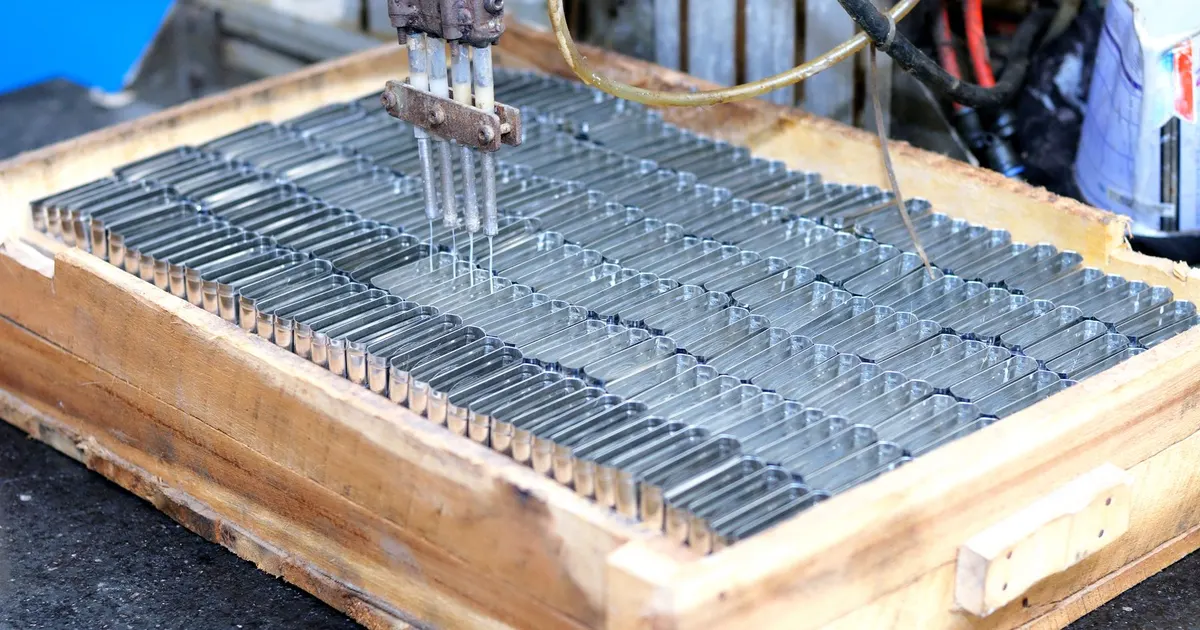
Brackets hold things. They carry sensors, hoses, wiring, shields, exhaust parts and whole subassemblies, and a typical vehicle contains hundreds. Each one is a simple part, a flat blank with a few bends, a few holes and sometimes a stiffening rib, but the way it is made changes the price by a large factor. A bracket that is cheap at one volume becomes expensive at another, because the die type, the material and the coating all follow the volume.
This guide shows how to match die type to volume, how to choose the steel and coating, and what to put on an RFQ so shops quote the same part.
What makes a bracket a stamping part
Brackets fit stamping well because they are flat to start and formed simply. A typical bracket has:
- A blanked outline, sometimes with a nested layout that saves material
- Pierced holes and slots for fasteners and locating pins
- One or more bends, often at 90 degrees
- Ribs, beads or flanges for stiffness
- Weld features, such as projections for projection welding or extruded holes for welded nuts
These features are in the die, so every part is the same. The cost drivers are the number of operations, the strip layout, the material and the tolerance on hole position and bend angle.
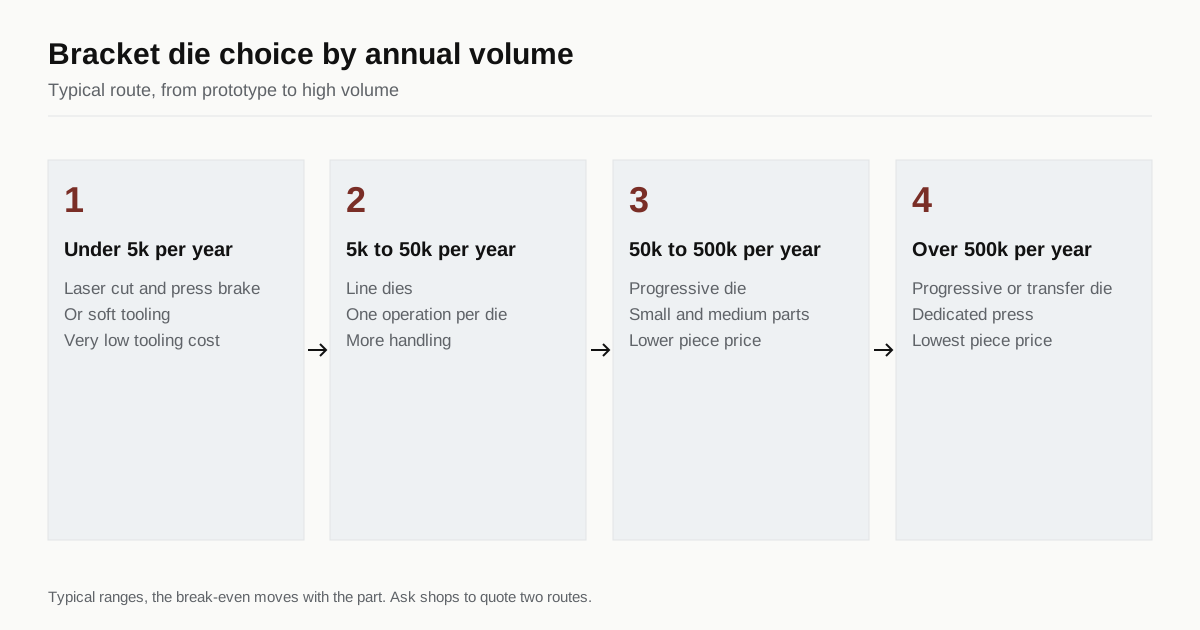
Die choice by volume
The same bracket can be made in four ways, and volume decides which is cheapest in total.
| Annual volume | Typical route | Tooling cost level | Piece price level |
|---|---|---|---|
| Prototype to a few thousand | Laser cut and press brake, or soft tooling | Very low | High |
| A few thousand to tens of thousands | Line dies, one operation per die | Low to moderate | Moderate, more handling |
| Tens of thousands to a few hundred thousand | Progressive die for small parts | Moderate to high | Low |
| Several hundred thousand and up | Progressive or transfer die, dedicated press | High | Lowest |
Line dies are simple dies run one after another. Each operation, such as blank, pierce, bend, has its own tool, and parts move between presses by hand or by conveyor. Tooling is cheap, but handling and labor add to the price. See progressive die vs transfer die vs deep draw for the full comparison.
Progressive dies hold every operation in one tool, with the strip stepping through. The part comes out at the end, finished. Tooling costs more, but labor per part is low and speed is high. Progressive dies suit small and medium brackets, within the width the strip and press can handle.
Transfer dies move individual blanks between stations with fingers. They suit larger parts, deeper forms and brackets with draws that a strip carrier cannot hold.
The break-even moves with the part. An extra bend, a tighter tolerance or a thicker material shifts the numbers, so ask for at least two routes in the quote, and see stamping tooling cost and die ownership.
For the steps before and after the die choice, see our guide to how to source stamped parts.
Material choices
The steel decides strength, formability and cost.
- Cold rolled steel. The default for lightly loaded brackets. It forms easily and costs the least.
- HSLA steel. Used when a bracket needs strength at a lower thickness, which can cut weight and material cost. It springs back more and cracks at tight bends, so radii and tolerances need care.
- Stainless steel. Used where corrosion matters, such as exhaust hangers, where ferritic stainless grades are common because they resist heat and cost less than austenitic grades.
- Aluminum. Chosen for weight in some applications, with its own forming rules.
See stamping steel grades for how the grades compare in the die. Name the grade by standard and strength, and state whether a substitute is acceptable.
Coatings and corrosion
Bare steel rusts, and automotive parts face road salt, moisture and heat. Typical protection includes:
- Zinc plating or zinc-coated strip, with a passivate for added resistance
- Zinc-nickel plating for higher corrosion performance
- E-coat, a paint applied by immersion and electric current that coats edges and recesses well
- Powder coat or paint for visible parts
Corrosion targets are normally set by the customer, often as hours of neutral salt spray before red rust. State the target and the test method on the print, not just the coating, since the same coating can perform differently depending on thickness and process. If a coating is applied after stamping, its thickness and edge coverage affect fit. See pre-plated strip vs plating after stamping for the options.
Tolerance and process capability
Brackets locate other parts, so hole position and flatness matter more than the outline. Typical callouts include:
- Hole position relative to datum features
- Bend angle and flange height
- Flatness of mounting faces
- Burr height and direction
Automotive programs often require proof that the process is capable, measured as Cpk, a statistic that compares the spread of a feature to its tolerance. Common targets are 1.33 for ordinary features and higher for critical ones. A shop proves capability by measuring a sample from a production run and reporting the result. Say which features are critical, since the shop must plan inspection and sometimes a more precise die. See metal stamping tolerances for what costs extra.
Quality documents
Automotive customers commonly ask for production part approval, and the shop must be able to supply it. The documents often include dimensional results, material certificates, process flow and control plans. Read the PPAP and IATF 16949 primer for the contents and what each level means. If you need PPAP, say so in the RFQ, since it adds lead time and cost to the first order. Do not assume a shop holds any certification. Ask for the certificate and check its scope and date.
Weld features and secondary operations
Many brackets are welded to a body or frame, and the features that make welding work are stamped in. Projection welding uses small raised dimples that concentrate current at the joint, and the dimples must be in the die. Extruded holes give a collar for a welded or clinched nut. Locating holes or tabs position the bracket in a welding fixture. If your bracket is welded, tell the shop how, because the weld feature changes the die and its cost.
Other secondary operations include tapping, clinched fasteners, deburring and coating. In a high volume program some of these move into the die, such as in-die tapping. See in-die tapping and die sensors. The guide on secondary operations after stamping lists what each adds to cost and lead time.
An illustrative volume example
The numbers here show the shape of the trade, not a quote. Take a small bracket with a blank, two holes and two bends. At about 5,000 parts a year, a laser-cut blank and a press brake need almost no tooling and give a high piece price, and the total over a year is low. At about 50,000 a year, a set of line dies costs more to build, lowers the piece price and wins on total cost within a year or two. At about 500,000 a year, a progressive die costs several times the line dies, yet the saving per part is large enough to repay it in months.
The curve is not smooth. Between each step the shop’s capacity, the press available and the part’s design all matter. A small design change, such as moving a hole away from a bend, can move the part from a two-operation die to a one-operation die. Ask each shop to name the volume at which it would switch routes, and keep that number with the quote so you can plan when to move.
Program life, change control and capacity
Automotive programs last years, and brackets change during that time. Plan for it:
- Engineering changes. Hole moves and thickness changes are common. Ask how the shop handles a change to an existing die, and what it costs.
- Program life. Quote tooling against the real program length. A die built for a one-year run is built differently from one built for seven years.
- Capacity. Ask which press the part will run on, the strokes per minute and the monthly capacity. A shop that is full cannot surge when your program does.
- Spare parts and service volumes. After the program ends, service parts continue for years. Ask whether the shop will keep the die and for how long, and how it prices small service orders.
- Packaging. Returnable trays and racks protect finished brackets and cut damage. State the packaging in the RFQ.
Tool ownership, storage and insurance matter more in long programs. See stamping die maintenance and tool life for the records to request.
Strip layout and material use
For a bracket in a progressive die, the strip layout decides how much steel becomes scrap. A smart layout nests parts closely and keeps the carrier narrow, which lowers the material cost per part. For a high volume bracket, a few percent in material use can be worth more than a change in press rate. Ask the shop what material yield its layout gives and whether it can improve it with a small change to the part outline. A part with an odd outline may nest poorly, and a small change can save material. This is one of the cheapest changes a buyer can make at design stage.
What to put on the RFQ
- Print with datums and critical features marked
- Material, grade, thickness and finish
- Annual volume, program life and release schedule
- Corrosion target and test method
- Quality documents required
- Tooling ownership and storage
- Packaging, such as returnable trays
- Whether you accept two die routes in the quote
The metal stamping RFQ checklist lists the other fields.
Checklist before you choose
- Estimate annual volume and program length.
- Ask for line die and progressive die quotes.
- Choose the steel by load, not habit.
- Set the corrosion target and the coating.
- Mark critical features and capability needs.
- Decide who owns the tooling.
When the print is ready, send the RFQ and compare shop replies within 24 business hours.
See also: the transfer die stamping reference.
Frequently asked questions
What volume justifies a progressive die for a bracket?
There is no fixed number, but progressive dies usually make sense once annual volume reaches the tens of thousands for a small bracket, because the higher tooling cost spreads over more parts. Ask shops to quote line dies and progressive dies side by side.
Do automotive brackets need PPAP?
Most automotive programs ask for a production part approval package, and the level depends on the customer. Tell the shop early if you need PPAP, since it adds documents, sampling and lead time.
Which steel is common for brackets?
Cold rolled steel for lightly loaded brackets and HSLA for brackets that need more strength at lower thickness. Stainless is used where corrosion matters, such as exhaust hangers. Coatings such as zinc or e-coat are applied for rust protection.
Need a quote for this part?
Send the print. We match you with up to 3 stamping shops and reply within 24 business hours.
Send my RFQ