Guides / Materials
Steel Grades for Stamping: How Cold Rolled, HSLA and Spring Steel Behave in the Die
November 6, 2026
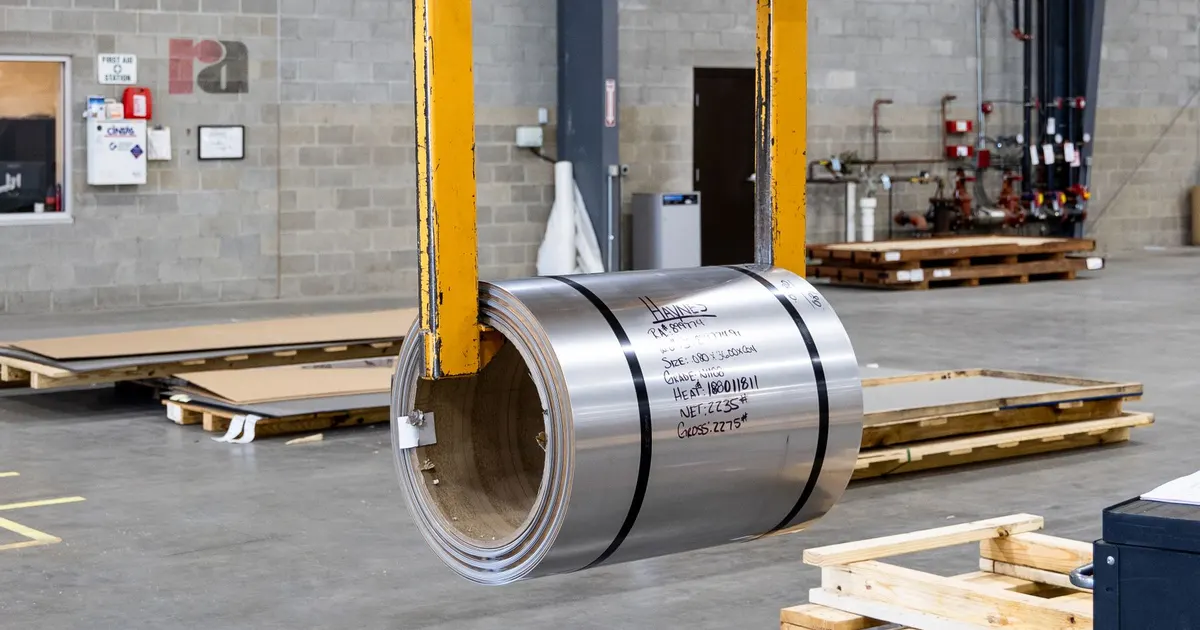
Most stamped parts are steel, and most steel for stamping is supplied as coil. The grade you name on the print sets how the strip forms in the die, how much it springs back, how fast the tools wear and what the finished part can carry. Three families cover most work: low carbon cold rolled steel, high-strength low-alloy steel and spring steel. Each answers a different problem, and the right choice can save more money than any tooling change.
This guide compares the three on strength, formability and cost, and shows how to name them so that the shop quotes what you need.
Cold rolled steel (CRS)
Cold rolled steel is low carbon steel that has been rolled to thickness at room temperature, then annealed. The result is a smooth surface, a tight thickness tolerance and good ductility. It is the default for brackets, covers, housings and most general stamping.
ASTM A1008 sets out the grades of cold rolled sheet. The grade names that matter to a stamper describe formability:
- CS, commercial steel. The general purpose grade for ordinary bending and shallow forming.
- DS, drawing steel. Softer and more ductile, for deeper forms.
- DDS, deep drawing steel. For difficult draws.
- EDDS, extra deep drawing steel. The most formable, for the deepest and most complex draws.
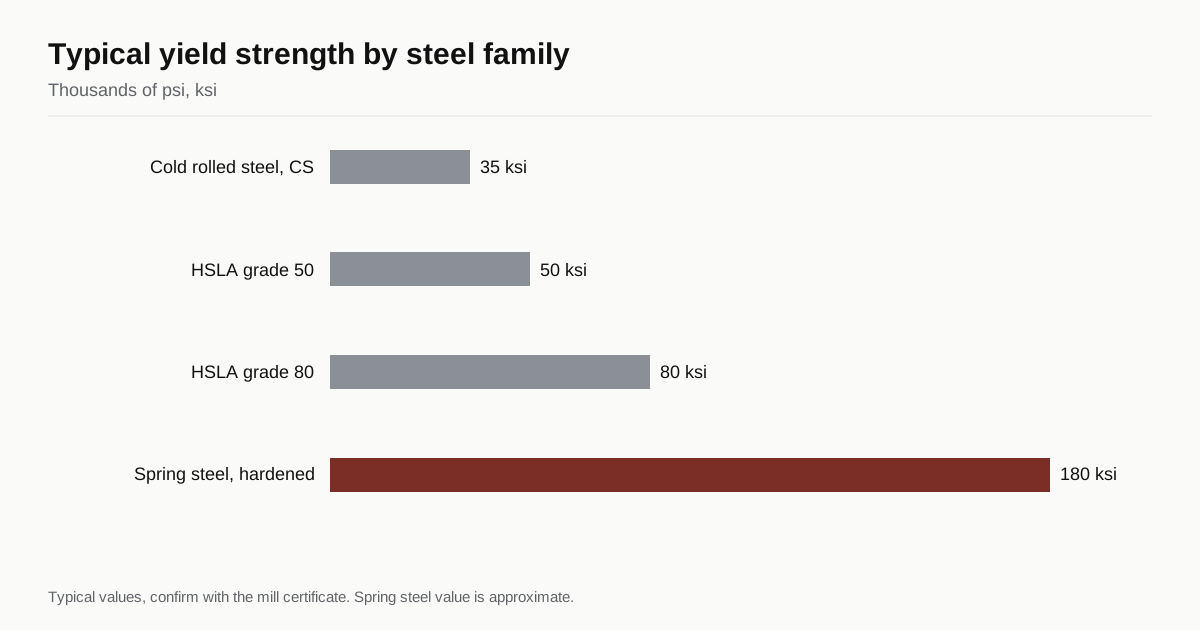
Cold rolled strip, supplied narrower and often to closer tolerances, is covered by ASTM A109. Common alloy designations include 1008 and 1010. Typical yield strength falls in the range of roughly 25 to 40 ksi depending on grade, and elongation is high. Springback is modest, which keeps die development simple.
CRS rusts if left bare, so parts are usually oiled, plated, painted or coated afterward. Pre-coated forms such as galvanized sheet are also available. See pre-plated strip vs plating after stamping for the edge questions that come with coated strip.
High-strength low-alloy steel (HSLA)
HSLA steels carry small additions of elements such as niobium, vanadium or titanium that raise strength without a large increase in carbon. They are named for minimum yield strength in ksi. A grade called 50 has a minimum yield of 50 ksi, a grade 80 has 80 ksi, and so on. Typical yield strength runs from about 40 to 80 ksi or more.
The reason to pick HSLA is weight and strength. A bracket in grade 50 can often be made thinner than the same bracket in mild steel, and the thinner part can cost less in material and weigh less. Automotive structural parts rely on this trade.
The costs show up in the die:
- Lower ductility. Elongation is lower, so tight bends and deep forms crack more easily. Minimum bend radii are larger, often at least one to two times thickness or more.
- More springback. Higher yield stores more elastic energy. The die must overbend further, and the result varies more from coil to coil.
- More tool wear and higher tonnage. Cutting force rises with strength, and tool edges wear faster.
Some HSLA grades are sold with improved formability, using tailored chemistry to reduce cracking in tight bends. Ask the mill or shop which variant is intended. For automotive parts, see stamped automotive brackets.
Spring steel
Spring steel is high carbon steel, with carbon content roughly from 0.5 to 1 percent. Common designations include 1050, 1065, 1075 and 1095. ASTM A684 covers cold rolled high carbon strip. The carbon lets the steel be hardened and tempered to high strength, with tensile strength often well above 200 ksi in the hard condition, and it lets a formed part return to its shape after load.
Spring steel comes in two practical forms:
- Annealed strip. Soft and formable. The shop stamps and forms the part, then hardens it by heating and quenching, then tempers it to the target hardness. Tight bends are possible, but heat treating can distort the part and adds a process step.
- Pre-hardened and tempered strip. Supplied already hard, often called blue tempered when it carries a blue oxide finish. The shop stamps it directly, so there is no heat treatment, but bend radii must be larger and tool wear is high.
Spring steel is the basis for clips, retainers and flat springs. For a deeper look, see stamped spring clips. Bare carbon spring steel rusts quickly and usually needs oil, plating or coating, and electroplated high-strength steel carries a hydrogen embrittlement risk that needs a baking step.
The grades compared
| Property | Cold rolled steel | HSLA | Spring steel |
|---|---|---|---|
| Typical yield strength | About 25 to 40 ksi | About 40 to 80 ksi or more | Very high after hardening |
| Formability | Excellent | Moderate | Limited when hard, good when annealed |
| Springback | Low | Higher | High, and intended |
| Tool wear | Low | Moderate | Higher in hard strip |
| Typical forms | Brackets, housings, covers, drawn shells | Structural brackets, reinforcements | Clips, springs, retainers |
| Relative cost | Baseline | Modest premium | Premium, plus heat treat if needed |
| Corrosion | Needs coating | Needs coating | Needs coating |
These figures are typical, and the actual values depend on the grade and the mill. Request the certificate for the coil you will use.
Grain direction and bend orientation
Steel strip has a grain direction set by rolling. Bends made across the rolling direction, with the bend line at right angles to the grain, tolerate tighter radii than bends made along it. The effect is small in soft cold rolled steel and large in HSLA and hard spring steel. A part with bends in two directions has one bend that is more likely to crack, and the layout of the part on the strip decides which one it is.
The print can help or hurt here. If the design needs a tight bend in a high-strength grade, say which bend is critical, or note that the grain should run a certain way. The shop can then orient the blank in the die strip to protect that bend, though this may cost some material yield. Nesting the part for the best material use and nesting it for the safest bend sometimes conflict, and the shop will price the choice. If the shop shows a different layout than you expected, ask why, because the reason is often bend orientation.
Edge condition and slit strip
Coil is slit to width from wider master coil, and the slit edge has its own condition. A sharp slitter leaves a clean edge with a small burr, while a dull slitter leaves a rough edge and a larger burr. Hard grades such as HSLA and spring steel are more sensitive, since a rough slit edge can start a crack in the first bend. For parts where edge cracking is a risk, ask for edge-conditioned strip, which has the edges rounded or trimmed to reduce the problem. Strip width and edge quality also affect feeding in a progressive die. The page on coil thickness and width tolerance covers this in detail.
Coated and pre-finished steel
Steel is often bought already coated. Zinc-coated steel, whether hot dip or electrolytic, protects against rust at low cost and is common for appliance and automotive parts. Pre-painted steel carries a finished color and saves a painting step. Both bring trade-offs. Coatings can flake in tight bends or draws, galvanizing can pick up on the tool and the cut edge is bare steel, so the edge is not protected by the coating itself. Zinc offers some sacrificial protection at a cut edge, but paint does not. If appearance or corrosion at the edge matters, discuss it with the shop before you choose between coated strip and a finish applied afterward.
How to name the grade on the print
A vague note such as “steel” invites a substitution. A good callout includes:
- The standard and grade, for example ASTM A1008 DS, or an HSLA grade with minimum yield
- Thickness and tolerance
- Finish, such as oiled, galvanized or pre-painted
- Temper for spring steel, or the hardness range after treatment, such as a target in Rockwell C
- Whether the shop may substitute an equivalent grade, and with what approval
Many prints are written around a legacy material. If you do not know why a grade was chosen, ask a shop whether a lower cost grade would pass. A change from HSLA back to cold rolled steel, or from spring steel to a stainless spring grade, may be possible if the load case allows it.
Cost, thickness and weight
Material often makes up a large share of piece price in stamping. The grade changes the price per pound, and also the thickness you need. HSLA costs more per pound than mild steel but may let you use a thinner gauge, so the material per part can fall. Spring steel costs more and may add heat treatment. Cold rolled steel is the cheapest option when strength is not the limit. When comparing quotes, ask each shop to state the grade and thickness it used, since two quotes may rest on different assumptions. How to read a metal stamping quote lists the other items to compare.
What to put on the RFQ
- Standard, grade and thickness, with the tolerance you need
- Required strength or hardness, if it matters to function
- Form and bend radii on the print
- Finish and corrosion requirement
- Annual volume
- Whether alternate grades are acceptable
The metal stamping RFQ checklist lists the other fields.
Checklist before you pick a grade
- Start with cold rolled steel unless strength or spring behavior forces a change.
- Consider HSLA when thickness and weight drive cost.
- Choose spring steel only when the part must return to shape.
- Check bend radii against the grade.
- Plan finish and corrosion protection.
- Name the grade by standard, and state whether substitutions are allowed.
When the print is ready, send the RFQ and compare shop replies within 24 business hours.
See also: the cold rolled steel for stamping: CS, DS, DDS, EDDS and DC01 to DC07.
Frequently asked questions
What is the most common steel for stamping?
Low carbon cold rolled steel is the usual starting point. It forms easily, costs less than the alternatives and is available in a wide range of thicknesses. Move to HSLA when you need more strength at a lower thickness, and to spring steel when the part must behave as a spring.
Why does HSLA spring back more than cold rolled steel?
Springback grows with yield strength. A higher strength steel stores more elastic energy in a bend and releases more of it when the die opens, so the die must overbend further to hit the target angle.
Can spring steel be stamped in the hardened condition?
Yes, in pre-hardened and tempered strip, but bends need larger radii and tool wear rises. The other route is stamping in the annealed condition and hardening afterward, which allows tighter forming but adds heat treatment and distortion risk.
Need a quote for this part?
Send the print. We match you with up to 3 stamping shops and reply within 24 business hours.
Send my RFQ