Guides / Materials
Beryllium Copper Stamping: Choosing a Temper, Planning the Heat Treat and Handling It Safely
October 21, 2026
Beryllium copper is the strongest of the common copper alloys. After a simple heat treatment it reaches tensile strength near or above 180 ksi, it flexes thousands of times without losing its spring force and it still conducts electricity. That is why it appears in connector contacts, probe tips, switch blades, battery contacts and spring fingers on EMI gaskets, where phosphor bronze runs out of strength.
It is also the most demanding copper alloy to buy and stamp. It has a heat treatment step that moves the part, a cost several times that of copper and a health and safety program that the shop must run correctly. This guide explains the tempers, the heat treat, the handling rules and how to decide whether the alloy is worth it.
What the alloy is
The standard high-strength grade is C17200, often called alloy 25, with about 1.8 to 2 percent beryllium and a small amount of cobalt. It is the grade most buyers mean by beryllium copper. Related grades include C17000, a similar alloy with slightly less beryllium. Lower beryllium alloys such as C17510 and C17410 contain far less beryllium, trade some strength for higher conductivity or lower cost and are used where heat transfer or current carrying matter more than peak strength.
The alloy hardens by precipitation. In the soft condition it is easy to form. After a controlled low-temperature aging cycle, tiny beryllium-rich particles form inside the copper and lock the structure, which raises strength several times over.
Temper codes
Beryllium copper strip comes in a set of tempers, in the old A, H and AT naming and in the newer TB, TD, TF and TM codes:
| Condition | Common code | What it means |
|---|---|---|
| Solution annealed | A or TB00 | Soft, easiest to form, ages to full strength later |
| Quarter, half and full hard | 1/4H, 1/2H, H or TD01, TD02, TD04 | Cold worked, stronger as supplied, ages to higher strength |
| Aged after forming | AT, 1/2HT, HT or TF00, TH02, TH04 | Strip aged by the mill or the shop, highest strength |
| Mill hardened | TM00 to TM08 | Aged at the mill before stamping, ready to form with limited radii |
Always write the alloy and temper together on the print, for example C17200 TD02, and say whether the part is to be aged after forming or supplied mill hardened.
Three routes to a finished part
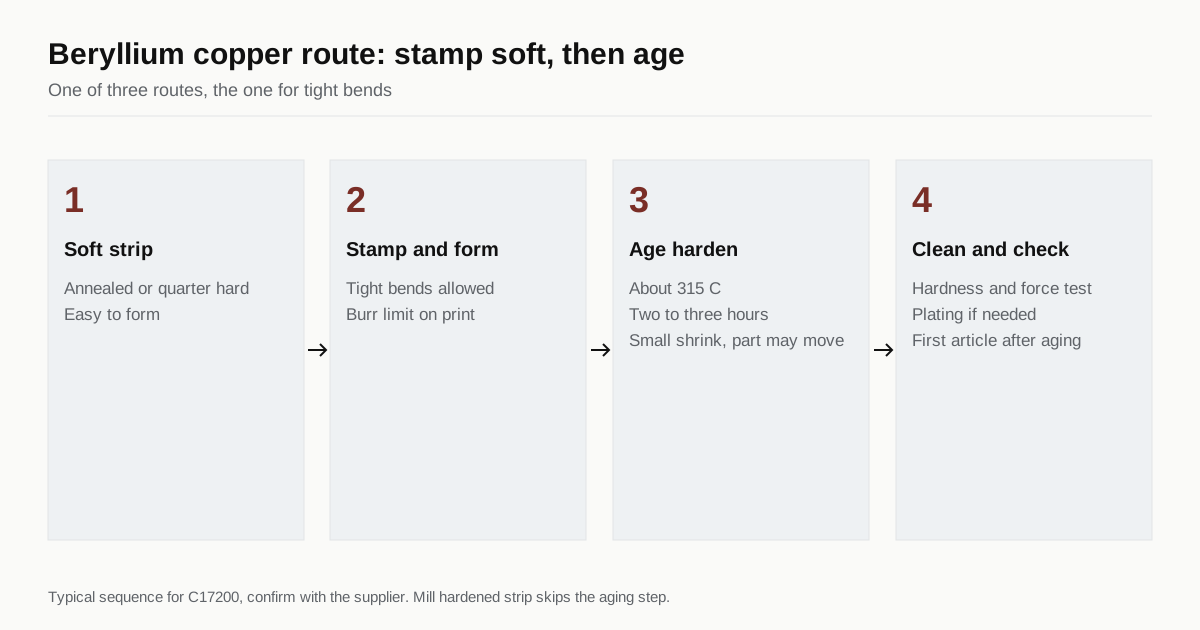
Route 1: stamp soft, then age. The shop forms the part from annealed or quarter hard strip, then ages it in a furnace, commonly at about 315 degrees C (600 degrees F) for two to three hours for the standard alloy. Forming is easy and tight bends work. The cost is a heat treat step, some part movement and a small dimensional change.
Route 2: mill hardened strip. The mill ages the strip first, so the stamping shop forms it directly and skips the furnace. This removes the distortion risk and the extra step, but bend radii must be larger, tool wear is higher and strength is a little below the fully aged condition.
Route 3: a lower beryllium or alternative alloy. Where the load allows it, a different alloy avoids the issue.
The right route depends on bend radius, tolerance and volume. Parts with tight bends and high spring force often go through Route 1. Parts with generous radii and tight dimensions often suit Route 2.
Dimensional change on aging
During aging, the alloy contracts slightly, usually a few tenths of a percent or less, and thin parts can warp. If the part has tight position tolerances, the shop must allow for the change in the die and may hold the part flat in a fixture during heat treat. Typically the shop forms an allowance into the die, measures a first lot and adjusts. That is why Route 1 asks for a trial run and why the first article after heat treat matters more than the first article from the press.
Furnace atmosphere matters too. Aging in air leaves an oxide layer, which a cleaning step removes. Parts to be plated need a clean surface, so cleaning and plating usually follow aging. Read pre-plated strip vs plating after stamping for how the finish interacts with the route.
Forming rules
Beryllium copper forms well when soft and poorly when hard. Bends across the rolling direction tolerate tighter radii than bends along it, so part layout on the strip matters. The harder the supplied temper, the larger the minimum bend radius. A spring contact that bends sharply should be formed in a soft or quarter hard condition and aged afterward. Shops also watch springback, which is high in harder tempers and varies from coil to coil. See stamped spring clips for the general rules on spring parts.
Health and safety
Beryllium is a health hazard in the form of airborne dust, fume or fine particles. Inhaling them can cause chronic beryllium disease, a serious lung condition, in people who become sensitized. Solid beryllium copper in finished form or as strip handled normally is not the exposure route. The risk comes from operations that create fine particles:
- Grinding, sharpening or polishing the material or the tooling that cuts it
- Machining, EDM and welding
- Abrasive cleaning
- Dry sweeping of dust
Stamping itself produces little airborne material, but a shop that runs beryllium copper should have a written beryllium program with exposure monitoring, controlled areas, housekeeping, protective equipment and medical surveillance where required. In the United States, OSHA’s beryllium standard for general industry, 29 CFR 1910.1024, sets an exposure limit and the required program elements. The shop’s safety data sheets should be available.
For a buyer, the practical steps are to ask which operations are done in house, whether the shop has experience with the alloy and how it controls grinding and die maintenance. A shop that has never run it should not learn on your order.
Tooling and press behavior
Soft beryllium copper stamps much like other copper alloys. It cuts with moderate force, smears a little at the edge and leaves a burr that needs a limit on the print. Once aged or supplied hard, it is far tougher. Cutting force rises and tools wear faster, so shops use better tool steels or carbide for volume. The material is also costly, so shops try to nest parts tightly and keep the carrier narrow, which makes the die design more demanding. Thin strip, common in contacts, calls for careful feeding.
Because the alloy is expensive, scrap rate during setup matters. A shop that needs a long trial to tune a die burns costly strip, and some pass that cost to the buyer as a setup charge or a minimum lot. Ask how the quote treats first-article material and whether strip used in setup is billed.
Inspection and documentation
Strength and spring behavior depend on the heat treat, so documentation matters. Typical records include:
- Mill certificate for alloy, temper and composition
- Hardness after aging, measured on the part or a witness coupon, often with a microhardness test on thin strip
- Heat treat record showing time and temperature for each furnace load
- Conductivity check, if electrical performance is critical
- Dimensional report after aging for the critical features
- Spring force or deflection test, if the part works as a spring
Name the tests you need on the print, with the acceptance range. Without a hardness range, the shop has only the heat treat schedule to rely on, and two shops can produce different results from the same schedule. For automotive or other regulated programs, the PPAP primer lists the documents buyers commonly ask for.
Where it is used
| Application | Why beryllium copper | Typical alternative |
|---|---|---|
| Connector contacts and terminals | Spring force and fatigue life with conductivity | Phosphor bronze |
| Test probes and sockets | Wear resistance and repeated cycling | Copper-nickel-silicon alloys |
| EMI spring fingers and gaskets | High spring force in thin section | Stainless spring grades |
| Switch blades and relay springs | Fatigue life and stable force | Phosphor bronze or spring steel |
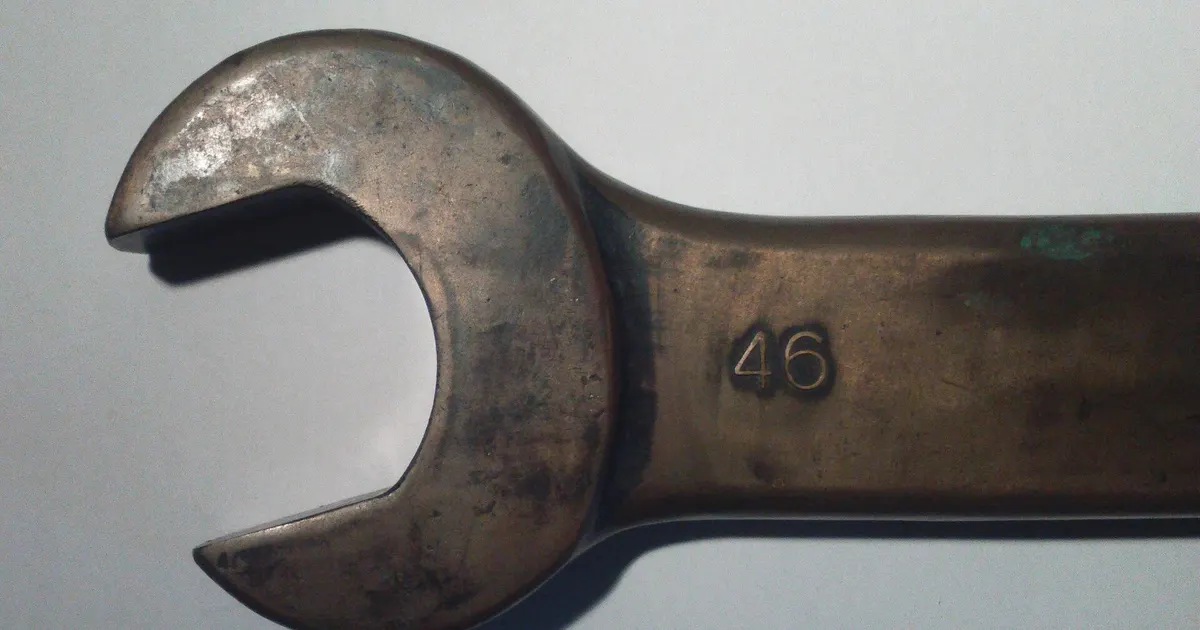
| Non-sparking tools | Strength without sparks, though not usually stamped | Aluminum bronze |
| Battery contacts | Spring force with corrosion resistance | Phosphor bronze with plating |
These are common patterns, not rules. A quick check with a shop that works with several alloys can often find a lower cost option that meets the actual load.
Cost
Beryllium copper strip costs several times as much as brass and notably more than phosphor bronze. Add heat treatment, the safety program and a shorter tool life in hard tempers, and the piece price rises further. Scrap has value, but it must be segregated and handled according to the program. Ask each shop how it prices the material and what it does with scrap. For a deeper look at quote items, see how to read a metal stamping quote.
Alternatives to consider
Before specifying beryllium copper, check whether another alloy meets the need:
- Phosphor bronze is lower in cost and strength, and it works for many contacts and springs. See copper, brass and phosphor bronze strip.
- Copper-nickel-silicon alloys give strength between phosphor bronze and beryllium copper, with good conductivity.
- Copper-titanium alloys approach beryllium copper in strength for some uses.
- Stainless spring grades work when conductivity is not needed.
- Low-beryllium grades for higher conductivity with less beryllium.
Each has limits in strength, stress relaxation at temperature and conductivity, so match the alloy to the load, the temperature and the current.
What to put on the RFQ
- Alloy, temper and whether the part is aged after forming or mill hardened
- Required hardness or strength after heat treat
- Thickness and tolerance
- Bend radii and critical angles
- Dimensional tolerances after aging
- Plating and cleaning requirements
- Safety data requirements
- Annual volume
- Whether alternate alloys are acceptable
The metal stamping RFQ checklist lists the other fields.
Checklist before you choose
- Confirm the load needs beryllium copper and not an alternative.
- Pick the route: age after forming or mill hardened.
- Set the bend radius for the temper.
- Plan for dimensional change after aging.
- Ask about the shop’s beryllium safety program.
- Compare the quote with at least one alternative alloy.
When the print is ready, send the RFQ and compare shop replies within 24 business hours.
Frequently asked questions
Why is beryllium copper used for springs and contacts?
After heat treatment it combines very high strength, good fatigue life, good electrical conductivity and no magnetic response. That mix is hard to get from other copper alloys, which is why it appears in connectors, probes and switch contacts.
Is stamping beryllium copper dangerous?
Solid beryllium copper is generally handled safely. The hazard is airborne beryllium dust or fume, which can come from grinding, polishing, machining and welding. Ask the shop about its beryllium safety program and where those operations happen.
Can I use a lower cost alternative?
Sometimes. Phosphor bronze, copper-nickel-silicon alloys and low-beryllium grades cover many applications at lower cost or lower hazard. The right alternative depends on the spring force, conductivity and temperature the part needs.
Need a quote for this part?
Send the print. We match you with up to 3 stamping shops and reply within 24 business hours.
Send my RFQ