Guides / Materials
Copper, Brass and Phosphor Bronze for Stamping: Picking the Alloy, Temper and Strip Spec
October 24, 2026
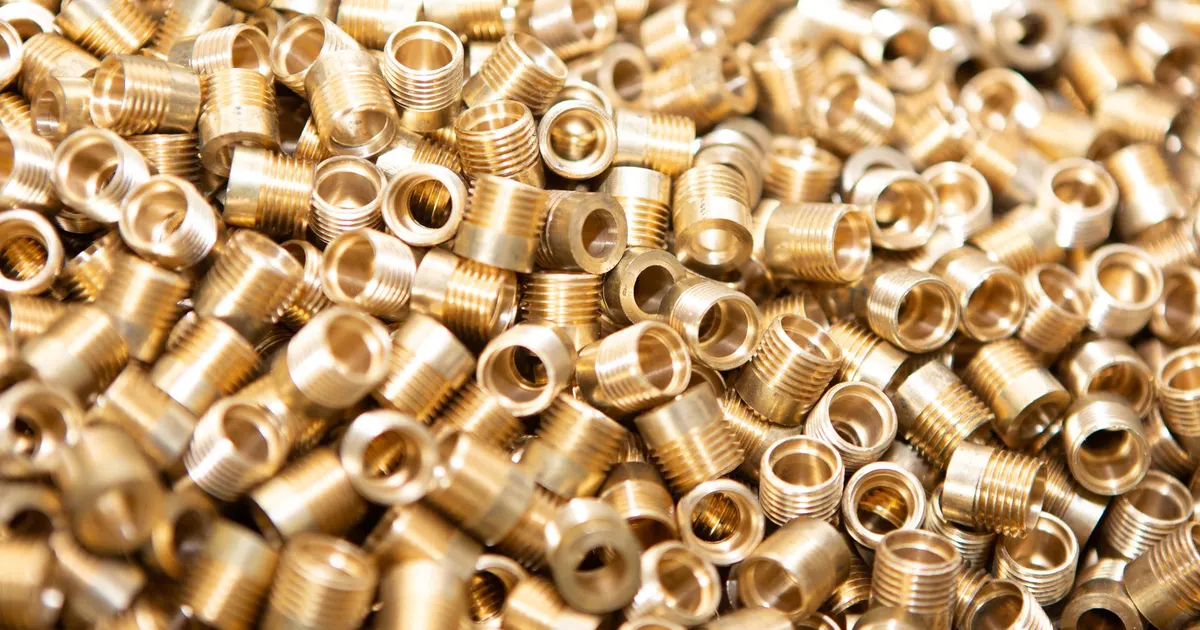
Copper alloys stamp well and carry current, resist corrosion and make good springs, which is why electrical contacts, terminals, connector shells and many small precision parts come from copper strip. The family is wide, though. Pure copper conducts best, brass draws best and phosphor bronze flexes best. Each gives up something to gain something else, and the alloy you name on the print decides conductivity, spring behavior and price.
This guide compares copper, brass and phosphor bronze for stamping, explains the temper codes and lists what to put on the RFQ.
Copper
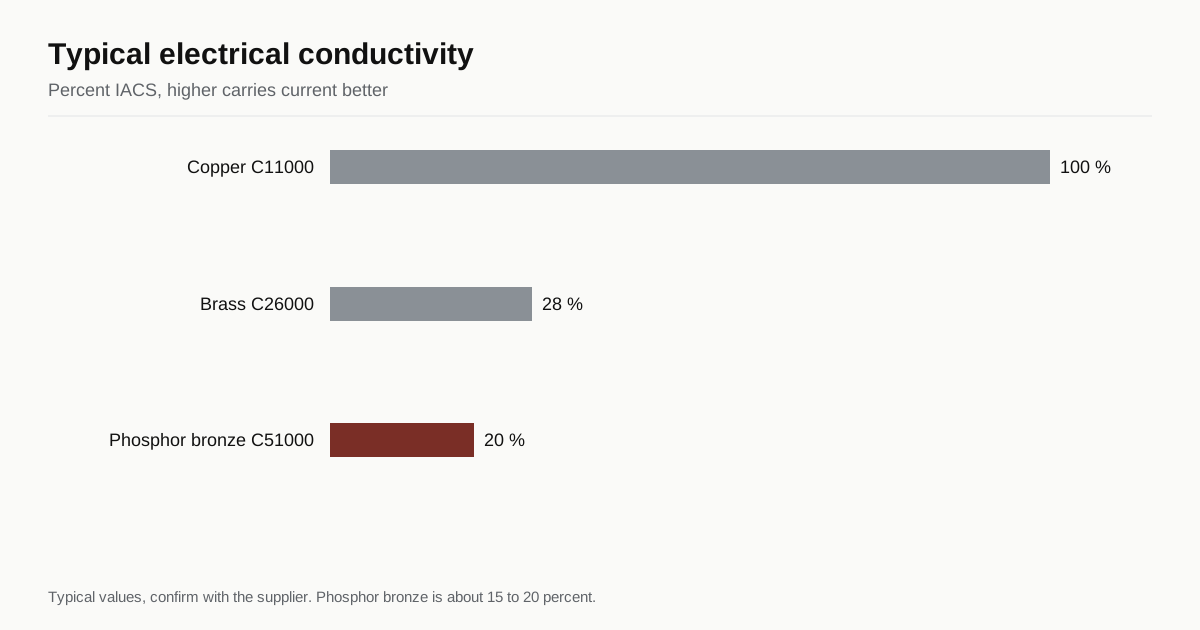
Pure copper in strip form is usually C11000, electrolytic tough pitch copper. It has the highest electrical and thermal conductivity of the group, with a rating near 100 percent of the International Annealed Copper Standard, written as 100 percent IACS. It is soft and ductile in the annealed temper and forms easily, but it is weak, and it work hardens when bent.
Copper suits busbars, heat spreaders, grounding straps and parts where conductivity decides everything. See busbar stamping for EV batteries for a use where copper dominates. Soft copper tends to smear at the cut and leave tall burrs, so burr limits need care. It also sticks to tool surfaces more than brass.
Brass
Brass is copper alloyed with zinc. The common stamping grade is C26000, cartridge brass, with about 70 percent copper and 30 percent zinc. It draws very well, which is why it makes cartridge cases and drawn shells, and it is stronger than pure copper. Conductivity is lower, around 28 percent IACS. Yellow brass such as C26800 is similar. Red brass with more copper, around 85 percent, has higher conductivity and a warmer color.
Brass is a general purpose choice for terminals, electrical hardware, decorative parts and drawn components. Its drawbacks are modest spring performance and, in some environments, dezincification, where zinc leaches out and leaves a weak porous structure. Free-cutting brasses with lead exist for machining but are not used for stamping. If lead content matters for compliance, name the requirement on the print.
Phosphor bronze
Phosphor bronze is copper alloyed with tin and a small amount of phosphorus. The common grades are C51000, with about 5 percent tin, and C52100, with about 8 percent tin. They are stronger than brass, resist fatigue and keep their spring force over many cycles. Conductivity is lower, roughly 15 to 20 percent IACS for the 5 percent grade and lower for the 8 percent grade.
That combination makes phosphor bronze the workhorse for contacts, springs, connector terminals, switch blades and parts that flex in service. The cost is higher than brass, and in hard tempers it needs larger bend radii. Bends across the rolling direction tolerate tighter radii than bends along it, so the part layout matters. See stamped spring clips for how that works on a spring part.
The three compared
| Property | Copper C11000 | Brass C26000 | Phosphor bronze C51000 |
|---|---|---|---|
| Electrical conductivity | About 100 percent IACS | About 28 percent IACS | About 15 to 20 percent IACS |
| Typical tensile strength, half hard | About 37 to 46 ksi | About 55 to 65 ksi | Higher, hard temper about 75 to 90 ksi |
| Formability | Excellent when soft | Excellent, best for drawing | Good in soft tempers, limited in hard |
| Spring properties | Poor | Fair | Very good |
| Fatigue resistance | Low | Moderate | High |
| Burr tendency | Tall, soft | Moderate | Moderate |
| Relative cost | Moderate | Lower | Higher |
| Typical uses | Busbars, heat spreaders | Drawn shells, terminals | Contacts, springs, connectors |
These are typical values, and the actual numbers depend on temper, thickness and the mill. Use them for comparison, not for design.
Temper codes
Copper alloy tempers follow a standard code. The ones you will see most often:
- O60 (soft anneal). Softest and most formable, lowest strength.
- H01 (quarter hard) and H02 (half hard). Moderate strength, still good for bending.
- H04 (hard). High strength, tighter limits on bending.
- H06 (extra hard), H08 (spring) and H10 (extra spring). Highest strength and spring force, with the least formability.
Harder tempers give more spring force and resist permanent set better, but tight bends crack. A common practice is to choose the hardest temper that the bends allow. Always name the alloy and temper together, such as C51000 H04. A part that needs a tight bend and spring force may use a softer temper formed first, with the final properties set in a later step, or a different alloy. A shop can advise on the right choice when it sees the bend radius.
Strip supply and tolerance
Copper alloy strip comes in thin gauges, down to a tenth of a millimeter or less, with tight thickness tolerances, because connector parts need consistent spring force. Strip width and thickness tolerances affect feeding and burr. Coil thickness and width tolerance explains what to ask the shop to hold. For spring parts, thickness variation changes the spring rate directly, so ask for a tighter strip tolerance if force matters.
Strip is sometimes supplied pre-plated with tin, nickel or gold. See pre-plated strip vs plating after stamping for the edge and cost questions that come with it.
How copper alloys behave in the die
Copper alloys are softer than steel, so cutting forces are lower, and tools last longer in terms of wear. The trouble is smearing. Soft metal drags along the cutting edge and leaves a rolled-over edge and a tall burr. Shops compensate with tight, well-maintained clearance, sharp tooling and lubricant. Copper also tends to cling to the tool, and the slug can pull back up out of the die, so slug control matters, with vacuum or air jets or special slug-retaining designs. The article on stamping die maintenance covers how sharpness is managed.
Thin strip creates its own problems. Strip below a few tenths of a millimeter wrinkles and tears easily, and feeding needs careful guides and low tension. High speed dies for connector terminals run fast, so the strip must be clean and consistent from the first meter of the coil to the last.
Residual stress and season cracking in brass
Cold worked brass carries residual stress after forming. In the presence of ammonia or amine vapors, even at low levels, stressed brass can crack days or weeks later, a failure called season cracking or stress corrosion cracking. It shows up in deep drawn and tightly formed parts that sit in humid or contaminated air. The cure is a low-temperature stress relief anneal after forming, usually in the range of a few hundred degrees C, which relaxes the stress without softening the part much. If your part is a drawn brass shell or a tightly bent brass part and will see an uncontrolled environment, ask the shop whether stress relief is part of the process, and write it on the print if needed.
Phosphor bronze and copper are far less prone to this, though stress and environment still matter. A related point: formed springs lose force over time if they are stressed near their limit, and a stress relief can raise spring performance in some alloys. Ask the shop how it handles relief for spring parts.
Other copper alloys worth knowing
The three alloys above cover most work, but a few others come up often:
- C19400, copper with iron. Good strength with conductivity near 60 percent IACS. A common lead frame and terminal alloy where both matter.
- Nickel silver, such as C75200. Copper, nickel and zinc with no silver in it. Silvery color, good strength and corrosion resistance, used for board-level shields and decorative parts. See EMI shield stamping.
- Beryllium copper, such as C17200. Highest strength of the copper family, with high conductivity after heat treatment. It needs special handling. See beryllium copper stamping.
- Cupronickel. Corrosion resistant in seawater, used in marine parts.
If your print calls for pure copper but the current only needs a few amps, a higher strength alloy may carry the load with a thinner section. If it calls for phosphor bronze but the part does not flex, brass may do. A shop with copper alloy experience will usually suggest alternatives.
Plating and finishing
Copper alloys tarnish, and electrical parts are often plated for contact resistance and solderability. Typical finishes include tin, nickel, silver and gold, usually over a nickel underlayer to block diffusion. Plating can be applied before stamping on strip, or after stamping on parts. Brass and copper accept plating well. Phosphor bronze needs good surface prep. State the finish, thickness and standard on the print, and say which surfaces need coverage.
Cost and scrap credit
Copper and its alloys follow the metal market, and price changes can be large. Shops often quote with a material basis and a surcharge or adjustment. Ask how the quote treats price changes and for how long it holds.
Copper scrap is valuable. Stamping leaves a skeleton of unused strip, and some shops credit the scrap value against the price, others keep it. The treatment can change the net piece price noticeably, so ask. For parts with a low material yield, the scrap treatment matters as much as the quoted price per kilogram. See how to read a metal stamping quote.
What to put on the RFQ
- Alloy and temper, for example C26000 H02 or C51000 H04
- Thickness and tolerance
- Minimum conductivity, if it matters
- Spring force or hardness requirement, if it matters
- Bend radii and critical angles
- Plating, thickness and standard
- Lead or restricted substance requirements
- Annual volume
The metal stamping RFQ checklist lists the other fields.
Checklist before you choose
- Decide whether conductivity, drawing or spring force matters most.
- Pick copper, brass or phosphor bronze to match.
- Choose the hardest temper that the bends allow.
- Set the plating and surface requirement.
- Ask how the quote treats metal price and scrap.
- Name the alloy and temper together on the print.
When the print is ready, send the RFQ and compare shop replies within 24 business hours.
See also: copper alloy strip specs for stamping: ASTM B152, B36 and B103.
Frequently asked questions
When should I choose phosphor bronze over brass?
Choose phosphor bronze when the part must act as a spring or carry repeated flexing, such as a contact or a terminal. It keeps its spring force and resists fatigue better than brass. For drawn shells and parts that do not flex, brass costs less and forms more easily.
What does the temper code mean on copper alloy strip?
Copper strip is sold in tempers from soft to spring hard, labeled with codes such as O60 for soft, H02 for half hard, H04 for hard and H08 for spring. Harder tempers are stronger and springier but crack at tight bends.
Can copper alloy parts be returned for scrap credit?
Copper alloy scrap has real value, and some shops credit it or price it into the quote. Ask how the shop treats skeleton scrap and whether the price assumes a credit.
Need a quote for this part?
Send the print. We match you with up to 3 stamping shops and reply within 24 business hours.
Send my RFQ