Guides / Materials
Stainless Steel Stamping: Choosing Between 301, 304 and 430 for a Stamped Part
November 1, 2026
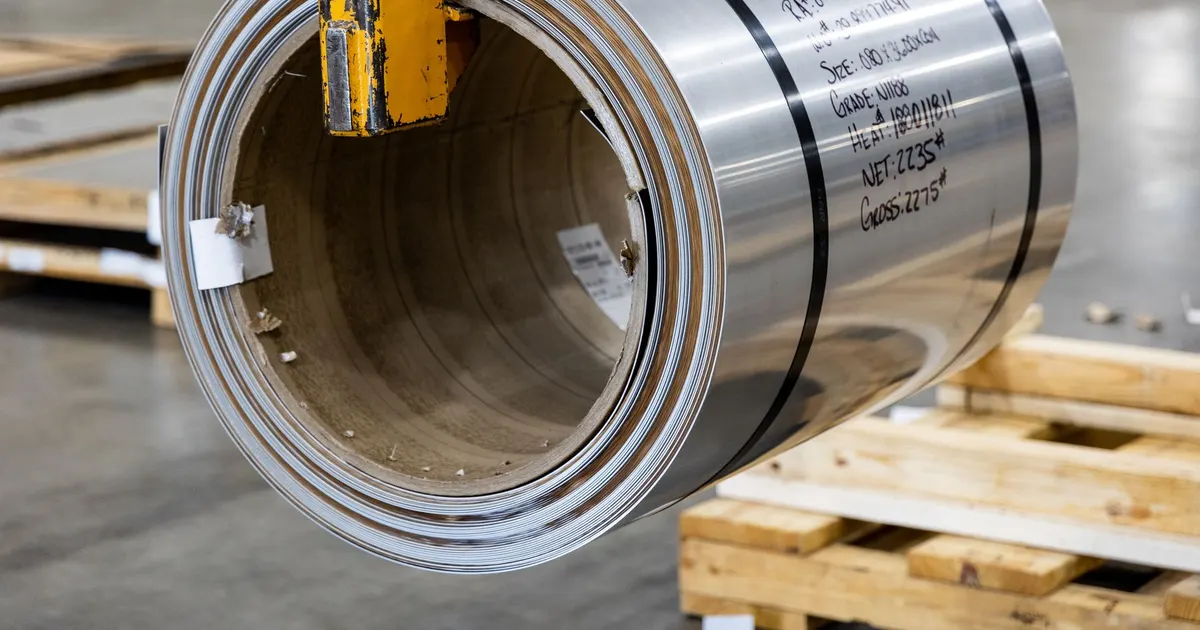
Stainless steel looks like one material, but three grades cover most stamped parts and they behave very differently in a die. A part that forms easily in 304 can crack in 430, and a clip that works in 301 may be unnecessarily expensive in 304. Choosing the grade early saves a trial run and a requote.
This guide compares 301, 304 and 430 on how they form, how they wear tools, how they behave after stamping and how to name them on the print.
What makes stainless different
Three traits drive almost every difference from mild steel:
- Work hardening. The austenitic grades, 301 and 304, get harder and stronger as they are bent, drawn or cut. A second operation meets stronger metal than the first, and a deep draw may need an anneal between stages.
- Higher strength. Cutting force is considerably higher than for mild steel. The press must be larger, and the tools wear faster. See stamping press tonnage for the shear strength values.
- Galling. Stainless tends to stick to tool steel under pressure and tear away material. Galled tools mark the part and wear quickly.
The chromium content that gives stainless its corrosion resistance forms a thin oxide layer on the surface. That layer needs to stay intact, which matters for tooling contact and for finishing after stamping.
Grade 301
Grade 301 is an austenitic stainless with slightly less chromium and nickel than 304. It work hardens very quickly, and that is its strength. Producers supply 301 in tempers from annealed through quarter hard, half hard, three-quarter hard and full hard. In the hard tempers it reaches high strength, so it is the usual stainless choice for spring clips, flat springs and contacts.
In the annealed condition, 301 forms well, and some shops draw or form it and then rely on the work hardening from forming to raise strength. In hard tempers, bends need larger radii and the cracks appear if the radius is too tight. Cold work also makes 301 partly magnetic. See stamped spring clips for how the tempers apply to spring parts.
Grade 304
Grade 304 is the general purpose austenitic stainless and the one most buyers think of first. It forms and draws well, accepts deep draws and resists corrosion in many environments. Its work hardening rate is lower than 301, so it stays more formable through several stages.
It suits housings, covers, brackets, food equipment parts and drawn cups. The price is higher than 430 and, because of the nickel content, it follows nickel market swings through surcharges. A deep draw in 304 often still needs lubricant, controlled draw speed and sometimes an anneal between draws. Deep drawn parts design rules sets out the limits.
Grade 430
Grade 430 is a ferritic stainless with chromium but no nickel. It is magnetic, work hardens little and costs less, and its price is steadier because it does not follow nickel. It forms well in shallow shapes, bends and light draws. It is less ductile than 304, so deep draws and tight bends are harder, and it can show a banded surface, called ridging, after heavy forming.
Corrosion resistance is lower than 304, and 430 is a poor choice for salt exposure or wet, aggressive service. It is common for appliance trim, panels and interior parts where cost matters and the environment is mild. Ferritic grades also lose toughness at low temperature, a point to check for cold service.
The grades compared
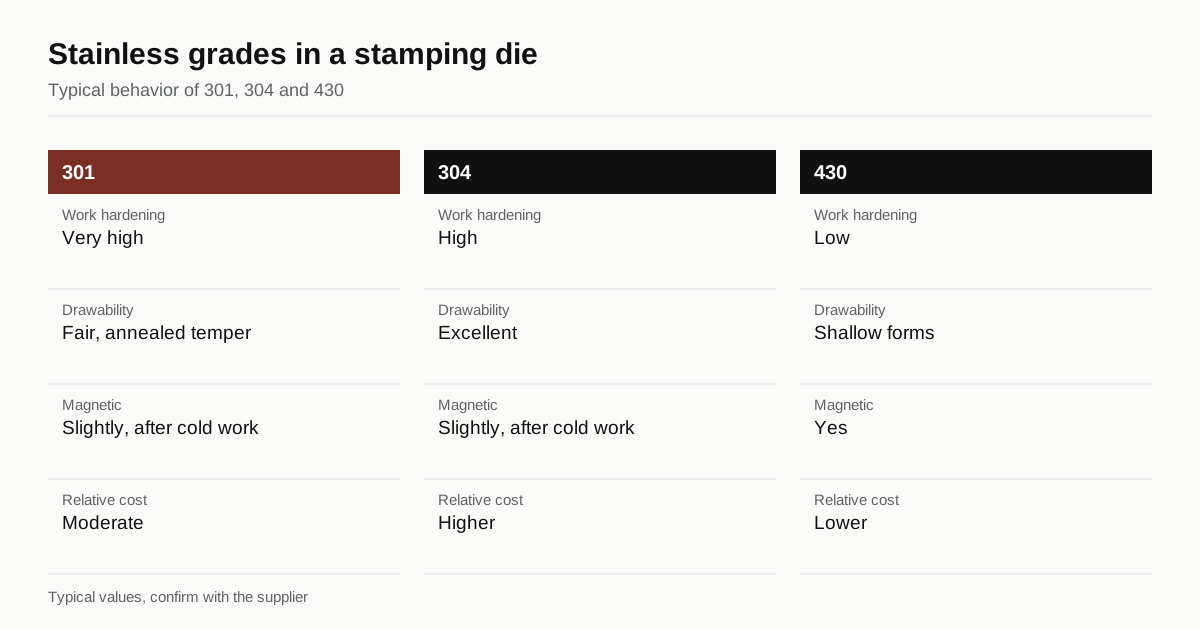
| Property | 301 | 304 | 430 |
|---|---|---|---|
| Structure | Austenitic | Austenitic | Ferritic |
| Magnetic as supplied | No, becomes slightly magnetic when cold worked | No, becomes slightly magnetic when cold worked | Yes |
| Work hardening | Very high | High | Low |
| Drawability | Fair in annealed temper | Excellent | Fair, shallow forms |
| Strength | Very high in hard tempers | Moderate | Moderate |
| Corrosion resistance | Good | Better | Lower |
| Springback | High in hard tempers | Moderate | Moderate |
| Relative cost | Moderate | Higher | Lower |
| Typical use | Springs, clips, contacts | Housings, drawn parts, food contact | Trim, panels, interior parts |
These are typical comparisons and the details depend on temper and thickness. Check the mill certificate for the actual lot.
Tools and lubrication
To keep galling and wear under control, shops adjust the tooling:
- Tool materials. D2 is common, powder metallurgy steels and carbide are used for volume, and coatings such as titanium nitride or similar reduce sticking.
- Clearance. Die clearance is often set a little larger than for mild steel, since stainless is stronger and work hardens at the cut edge. The exact figure is shop-specific.
- Lubricant. Heavy-duty drawing and stamping compounds keep metal from touching the tool directly. Parts may need a wash afterward.
- Polished surfaces. Draw radii and forming surfaces are polished to lower friction.
Tool life is shorter than in mild steel, and sharpening comes more often. See stamping die maintenance and tool life for the questions to ask.
After stamping: cleaning and passivation
Stainless relies on its surface oxide, and stamping can damage it. Steel particles from tooling can embed in the surface, and these free iron specks rust. Parts for demanding service are cleaned and passivated, a chemical treatment that removes free iron and restores the oxide layer. ASTM A967 covers passivation treatments, and ASTM A380 covers cleaning and descaling. Name the standard and the method on the print if corrosion matters, since the shop usually sends parts to an outside processor.
Pre-finished stainless often carries a protective film on one or both faces. The film guards against scratches during forming, so tell the shop which faces are visible. Brushed and mirror finishes show every mark, and the die must keep the surface clean.
Springback, burr and flatness
Higher strength means higher springback. A 90 degree bend in stainless opens more than the same bend in mild steel, so the die overbends. The amount varies from coil to coil, and harder tempers vary the most. If angle tolerance is tight, ask the shop how it controls the process and what it measures. Burrs from stainless are tough and can cut skin, so a burr limit and direction belong on the print. See stamping burr height.
Flatness can suffer from residual stress, especially in hard tempers, so large flat parts may bow after blanking. Ask whether the shop levels parts or uses a different strip temper.
Choosing by environment and function
Start from what the part must survive, then pick the grade that does it at the lowest cost:
- Indoor, dry service, appearance parts. 430 is often enough, and it saves cost.
- Food contact, humid or cleaned-in-place equipment. 304 is the usual choice, because corrosion resistance and cleanability matter.
- Coastal air or chlorides, such as salt and some cleaning agents. 304 may pit over time. Higher alloyed grades such as 316 are used there, though they cost more and are outside the three covered here.
- Springs and contacts. 301 in a spring temper, because of its strength and fatigue behavior.
- Magnetic function. 430 if the part must be magnetic, or an austenitic grade if it must not be. Cold work in 304 and 301 changes magnetic response, so set a limit.
Many designs start with 304 by habit. It is a good default, but when a part is a shallow stamped cover in a dry room, moving to 430 can cut material cost with no loss in function. Ask a shop to quote both when the environment allows.
Cost drivers specific to stainless
Material is a large part of the price of a stainless part. Austenitic grades carry nickel, and mills add surcharges that follow the metal market, so the price per pound moves from month to month. Ask each shop how it handles the surcharge, whether the quote fixes a price for a period or passes changes through. Beyond the material, stainless adds:
- Higher tool cost, because harder tool steels and coatings are used
- Shorter intervals between sharpenings
- A larger press for the same part, because of higher cutting force
- Lubricant and washing costs
- Passivation, if required, usually sent out
- More scrap in difficult draws
Scrap deserves a mention. A draw that cracks wastes expensive material, so shops build a scrap allowance into the price. A more forgiving grade or a redesigned radius can lower that allowance. The stamping tooling cost and die ownership article covers how tooling and material combine in the quote.
A deep draw in 304 as an example
A drawn cup in 304 shows the effect of work hardening. The first draw forms the cup to a fraction of its final depth. By the end of that draw, the wall near the punch radius is much harder than the starting strip. A second draw pushes the same metal further and meets that hardness, so the risk of cracking rises. After the second draw, the shop may anneal the part to soften it, then draw again. Each anneal adds a process step, cost and a cleaning step to remove scale.
In 430, the same cup may not reach the same depth at all, since the ferritic structure stretches less. That is the practical difference. A depth that is routine in 304 can be impossible in 430, and the print should not assume one grade can stand in for another without a trial.
What to put on the RFQ
- Grade, standard and temper, such as 304 annealed or 301 half hard
- Thickness and tolerance
- Surface finish and which faces are visible
- Cleaning or passivation requirement, with the standard
- Magnetic response limit, if any
- Bend radii and critical angles
- Annual volume
State whether the shop may propose another grade if it lowers cost or improves yield. Often a shop knows that 430 or 304 will work where the print asks for 301. The metal stamping RFQ checklist lists the remaining fields.
Checklist before you choose
- Decide whether the part is a spring, a drawn shape or a flat panel.
- Use 301 for springs, 304 for drawn and general parts, 430 for cost-driven trim.
- Check bend radii against the temper.
- Plan cleaning and passivation.
- Set burr limit and direction.
- Ask whether an alternative grade would pass.
When the print is ready, send the RFQ and compare replies within 24 business hours.
See also: ASTM A240 and A666 stainless sheet and strip for stamping.
Frequently asked questions
Why does stainless steel wear out dies faster than mild steel?
Stainless work hardens as it is cut and formed, and it is stronger to begin with. It also galls, which means it can pick up on the tool surface. Together these raise cutting force and wear, so shops use better tool materials, coatings and lubricants.
Is 430 a cheaper substitute for 304?
It can be, since 430 has no nickel and its price is steadier. But it is less ductile and less corrosion resistant, so it suits shallow forms and mild environments better than deep draws or wet service. Check with the shop before substituting.
Why is some 304 magnetic after stamping?
Austenitic grades like 304 and 301 are normally non-magnetic, but cold work converts part of the structure to a magnetic phase. Heavily formed areas can attract a magnet. If magnetic response matters, state a limit on the print.
Need a quote for this part?
Send the print. We match you with up to 3 stamping shops and reply within 24 business hours.
Send my RFQ