Guides / Process
Coil Strip Tolerance in Stamping: How Thickness, Width and Camber Reach Your Part
October 23, 2026
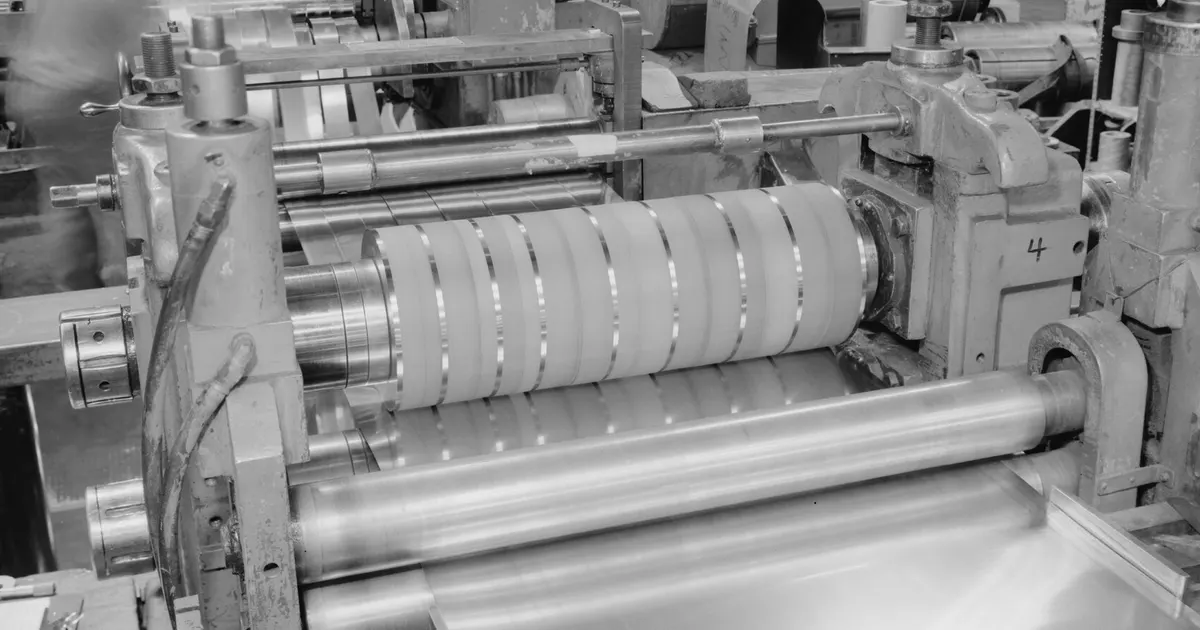
A stamping die copies whatever the strip gives it. The tool is built once, to one thickness and one width, and the coil that feeds it varies from the start of the coil to the end and from one coil to the next. That variation shows up as burr that grows and shrinks, bend angles that drift, a strip that binds in the guides and parts that go out of tolerance for no obvious reason. Many stamping problems that look like die problems trace back to the coil.
This guide explains the strip tolerances that matter, what each does inside the die and when it pays to ask for tighter material.
The strip properties that matter
Five properties of the coil reach the part:
- Thickness. The distance between the faces, and how much it varies along and across the strip.
- Width. The distance between the edges, mostly set by slitting.
- Camber. The sideways bow along the length of the strip.
- Coil set and crossbow. Curvature along the length, left from coiling, and curvature across the width.
- Edge condition. The shape of the slit edge, including its burr and any rounding.
Each has a tolerance in the order, and each interacts with the die differently. Standards set commercial tolerances for each material family, such as ASTM A568 for steel sheet, ASTM B248 for copper alloy strip and the Aluminum Association’s ANSI H35.2 for aluminum, and closer limits are available at a price.
Thickness: the most important one
Strip thickness changes three things at once.
Cutting clearance. The die is built with a fixed gap between punch and die. That gap is a percentage of strip thickness. On a thin strip it becomes a larger percentage, and on a thick strip a smaller one. Too large a clearance gives a taller burr and more die roll. Too small gives secondary shear and faster wear. If thickness drifts by ten percent, the clearance percentage drifts with it, and the burr follows. See stamping burr height.
Bend angle and springback. A thicker strip is stiffer, so it springs back differently. A bend that hits the print angle on one coil can open or close a degree on the next.
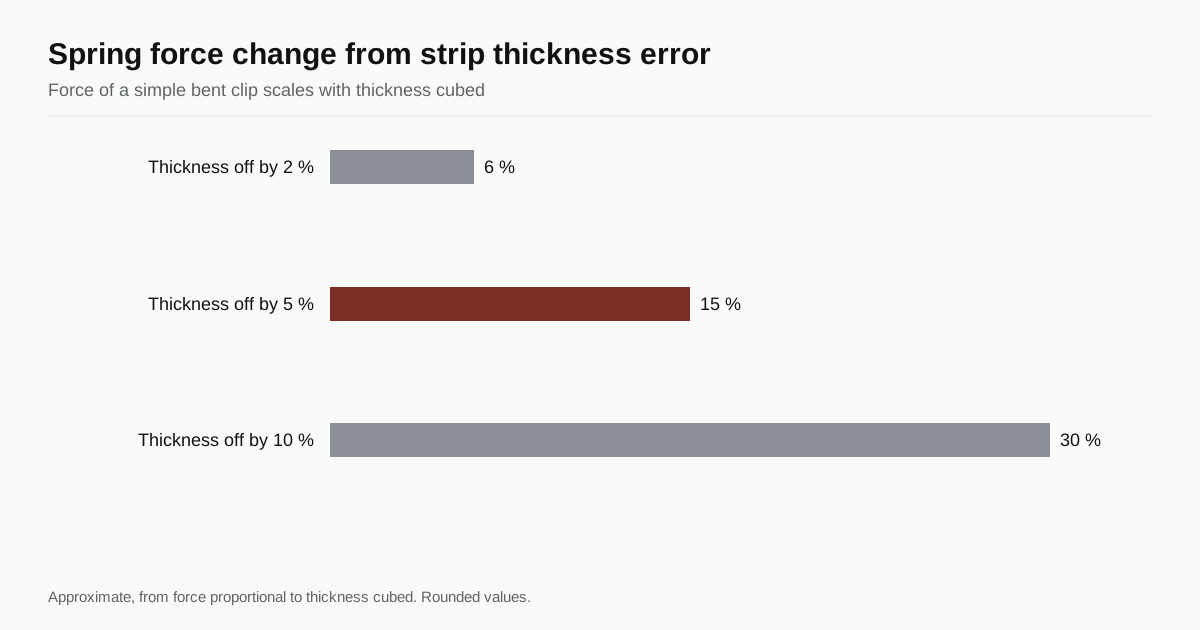
Part function. For spring parts, stiffness depends on thickness cubed in a simple bend. A five percent change in thickness changes spring force by about sixteen percent. If a clip must deliver a stated force, the thickness tolerance on the strip controls it more than any die setting.
Thickness is not constant across the strip either. Rolled strip is often slightly thicker at the center than at the edges, and a coil can vary from head to tail. Shops measure at several points, often a short distance in from each edge and in the middle.
Width and camber
In a progressive die, the strip runs through guides that locate it from the sides. Guide width is set slightly above the strip width. A strip that is wider than the guide binds. One that is narrower than the guide wanders, and the pilots then have to correct the position at each stroke. Camber makes both problems worse, since a curved strip drifts against one guide and binds against the other.
The effects show up as:
- Misfeeds and stops
- Uneven web width between the part and the edge, which changes the carrier strength
- Parts cut off center, with burrs on one side
- Damaged guide rails and pilots
Slit strip comes with a width tolerance that is typically a few thousandths of an inch for narrow strip, and tighter for precision slitting. Camber is specified as a maximum deviation over a stated length. For strip that runs fast in a progressive die, ask the shop what camber its feed line tolerates and what the coil supplier guarantees.
Coil set, crossbow and flatness
Strip coiled tightly keeps a memory of the curve. Coil set curves the strip along its length, and crossbow curves it across the width. A straightener at the press feed removes most of it, but heavy set, especially in hard or thick strip, can survive and distort the part. Hard tempers and high-strength steels are most sensitive. Large flat parts suffer first, since a slight bow shows as poor flatness. If flatness matters, ask whether the shop uses a straightener and what it does for your material, and consider metal stamping tolerances when setting the print.
Edge condition
The slit edge of a coil has a burr and a shape of its own. A clean, sharp slit leaves a small burr, and a dull slitter leaves a larger, rougher edge. In hard materials, a rough edge can start a crack at the first bend. In a progressive die, the edge of the strip rides against guides, and a heavy burr can drag. Options include edge-conditioned strip, with the edge rounded or deburred, and precision slitting with a closer cutter fit. Specify when edge cracking or guide wear is a concern. For coil sourcing and slitting practice, see the discussion of strip in stamping steel grades.
Typical tolerance levels
| Strip property | Commercial | Precision | What tighter buys |
|---|---|---|---|
| Thickness | A few thousandths of an inch, depends on gauge and width | Often half or less of commercial | Stable burr, angle and spring force |
| Width | A few thousandths of an inch | Tighter slitting | Reliable feeding and carrier width |
| Camber | Looser limit over length | Tighter limit | Fewer binds and misfeeds |
| Coil set | Straightener corrects most | Better flatness from the mill | Flatter parts |
| Edge | Slit edge as-is | Conditioned edge | Fewer edge cracks |
| Price | Baseline | Premium | Lower scrap and fewer stops |
These are typical categories and the numbers depend on material, thickness and width. Read the order standard and the mill certificate for actual values.
When to ask for tighter strip
Tighter strip costs more, so use it where it earns its price:
- Spring parts, where force depends on thickness.
- Tight bend angles, where springback must stay stable.
- Fine blanking and thin material, where clearance is a small gap.
- High speed progressive dies, where feeding stability decides uptime.
- Coined or embossed features, where depth depends on thickness.
- Precision electronic parts with tight tolerances on small features.
For general brackets and covers, commercial strip is fine.
A worked example: clip force and thickness
A flat spring clip is made from strip with a nominal thickness of 0.40 mm and a commercial tolerance of plus or minus 0.02 mm, which is five percent each way. Because the stiffness of a simple bent beam scales with thickness cubed, the strip at the thin limit gives a force about 14 percent below nominal, and the strip at the thick limit gives about 16 percent above. The same die and the same setup produce clips that span a wide force range, and no die adjustment fixes it, because the variation sits in the material.
If the print requires force within plus or minus ten percent, the shop has three choices: buy tighter strip, sort the strip by measured thickness and run it in groups with different die settings, or sort or test the finished clips. Each costs something, and the cheapest is usually tighter strip, bought once. Ask early. The same logic applies to any part whose function depends on stiffness, such as contacts and retaining springs.
Lot-to-lot variation and coil handling
Variation between coils is often larger than variation inside one coil. A new coil may differ in thickness, temper and surface from the last one, so a die setting that was perfect on the first coil may be off on the second. Shops handle this by setting up on each new coil and checking the first parts. For critical parts, ask whether the shop reserves a single coil or heat for the entire order, or tests each coil on arrival.
Coil dimensions matter at the feed. Coil inner and outer diameter and weight must fit the decoiler of the press line. A coil that is too heavy or too wide cannot be loaded, and a coil with welded splices can jam the feed or the die. Ask the supplier to mark or reject splices, and ask whether the shop can run through them. If you buy the material and consign it to the shop, agree the coil specification in writing, including diameters, weight and packaging. The checklist of questions in how to choose a metal stamping supplier includes material handling.
Incoming inspection
A good shop checks the coil before it runs:
- Reads the mill certificate for alloy, temper and thickness
- Measures thickness with a micrometer at several points across the width
- Measures strip width with calipers or a gauge
- Checks camber against a straightedge over a stated length
- Looks at the edge and the surface for damage or rust
Ask what the shop records and whether the record follows the lot. If a problem appears during a run, the record shows whether the coil was within order limits. Related material properties for copper alloys appear in copper, brass and phosphor bronze strip for stamping.
What to put on the RFQ
- Material, temper and nominal thickness
- Thickness tolerance, if function depends on it
- Any spring force or stiffness requirement
- Edge condition requirement, if edge cracking is a risk
- Flatness requirement on large parts
- Annual volume
State the tolerance you need and ask each shop which strip tolerance its price assumes. The metal stamping RFQ checklist lists the other fields.
Checklist before you order
- Decide which strip properties affect function.
- Set thickness and edge requirements only where needed.
- Ask which tolerance class the quote assumes.
- Agree on incoming inspection and records.
- Ask how the shop handles a coil that drifts mid-run.
- Compare quotes on the same strip assumption.
When the print is ready, send the RFQ and compare shop replies within 24 business hours.
See also: the cold rolled steel for stamping: CS, DS, DDS, EDDS and DC01 to DC07.
Frequently asked questions
Does strip thickness tolerance matter if my part tolerance is loose?
Less, but still for process stability. Thickness variation changes cutting clearance and bend angle, which shows up as burr changes and angle drift. Parts with loose tolerances tolerate it, while spring parts, tight bends and coined features do not.
What is camber?
Camber is the sideways curve of a strip along its length, like a banana shape seen from above. Too much camber makes a strip bind in the guides of a progressive die and can cause misfeeds.
Who should specify coil tolerance, the buyer or the shop?
The buyer should state tolerances that affect function, and the shop should state the tolerance its quote assumes. If the quote assumes commercial strip and your part needs tighter, say so before the order, since precision strip costs more.
Need a quote for this part?
Send the print. We match you with up to 3 stamping shops and reply within 24 business hours.
Send my RFQ