Guides / Process
Appliance Stamping: How Housings, Panels and Drawn Cans Are Made and What Shops Need to Quote
October 19, 2026
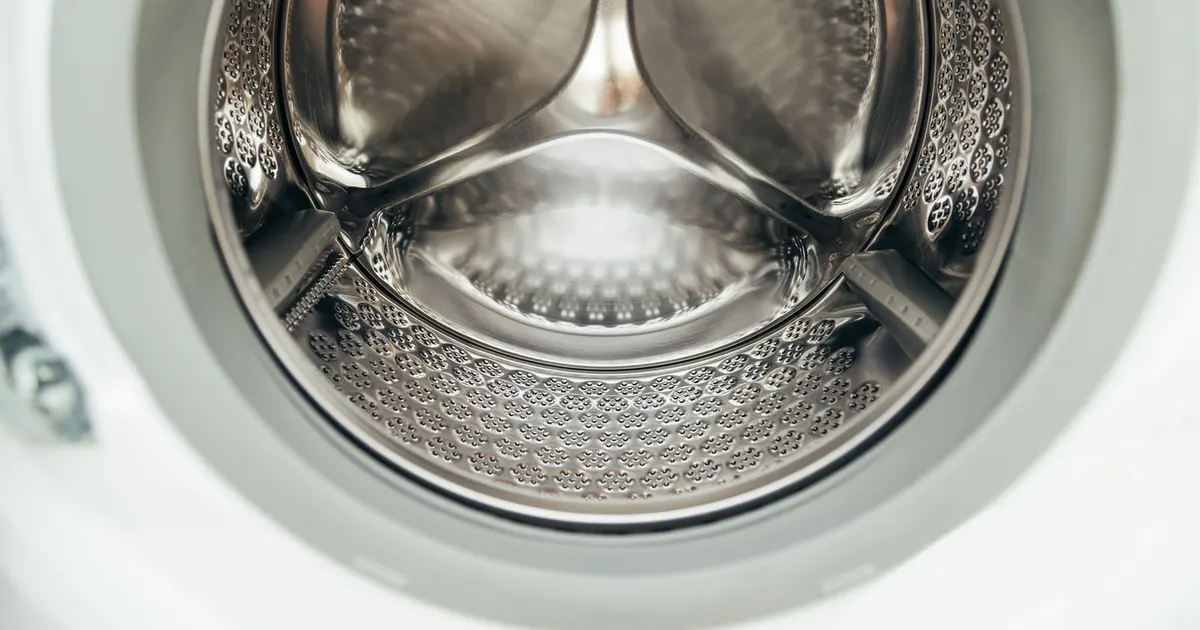
An appliance is mostly sheet metal. The cabinet of a washer, the door of an oven, the liner of a refrigerator, the drum of a dryer and the shell of a motor all begin as flat steel and become parts in a press. Appliance stamping sits between general brackets and automotive body work. The parts are large, but the tolerances are looser than auto, and volumes are steady for years. Finish matters more than almost anything else, because a customer sees and touches the panel every day.
This guide covers the main part families, the dies and materials behind them, the finish limits worth setting and what to put on the RFQ.
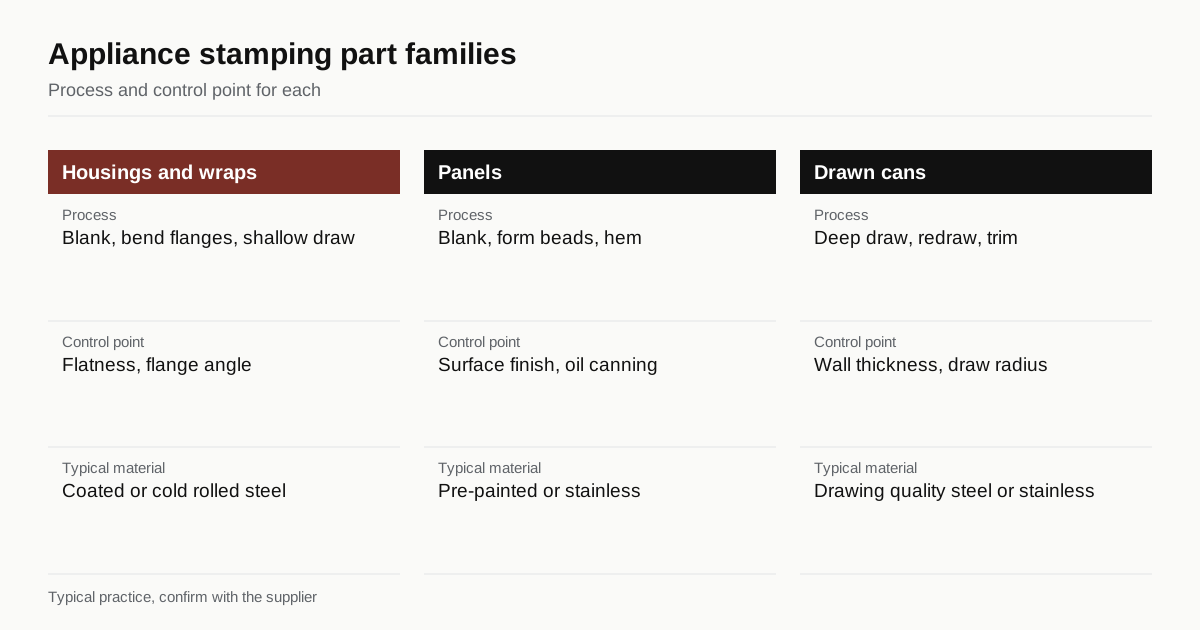
The three part families
Housings and wraps. Cabinets, covers and enclosures made by blanking a flat sheet, bending flanges and sometimes forming a shallow draw. They are often large and thin, with bends on all sides and holes for controls, wiring and fasteners.
Panels. Doors, side panels, back panels and fronts. These are mostly flat with beads or ribs for stiffness and edges that are hemmed or flanged. Surface quality is the main issue, since dents, waves and scratches show.
Drawn cans and shells. Tubs, drums, pots, motor cans and liners made by deep drawing a blank into a cup, sometimes redrawing and ironing it. The key quantities are wall thickness, depth and the condition of the draw radius.
Dies and presses
Appliance dies are big. A panel die may measure a meter or more across, and it runs in a large press with a long bed.
- Single-hit dies blank, pierce or form one operation per hit and work in a line of presses. They are common for panels and large housings.
- Tandem press lines pass a part from press to press, with each press carrying one operation. A panel might go blank, draw, trim, flange, pierce.
- Transfer dies move the part between stations inside one press, which saves floor space and handling for medium parts and drawn cans.
- Progressive dies suit smaller appliance parts, such as brackets and clips, at high volume.
See progressive die vs transfer die vs deep draw for the trade-offs. Large dies cost far more than small ones and take months to build, so lead time and ownership terms need to be clear. Stamping tooling cost and die ownership covers the main points.
Materials
The usual appliance materials are:
| Material | Typical use | Why |
|---|---|---|
| Drawing or deep drawing quality cold rolled steel | Drawn cans, shells, panels | Forms well, low cost |
| Zinc-coated steel | Cabinets, back panels, internal parts | Rust protection without a paint line |
| Pre-painted steel | Visible panels | Finish applied before stamping |
| Stainless steel, often 430 or 304 | Visible trim, drums, liners | Corrosion resistance and appearance |
| Aluminum | Cookware-type parts, light covers | Weight and heat transfer |
Name the grade by standard and the drawing class. See stamping steel grades and stainless steel stamping for how these behave in the die. Coated and pre-painted steel needs care because the coating can flake in tight bends and draws, and the cut edge is bare.
Drawing cans and shells
Deep drawing pulls a flat blank into a cup. Each draw stretches the wall and thickens the flange, and there is a limit to how deep one draw can go. A common rule says that a first draw in steel can reduce the blank diameter to roughly half, and deeper parts need redraws, often with an anneal between them. Wall thinning, wrinkling and splitting are the defects. Control comes from the blank holder force, draw radii, lubricant and the right material grade. The rules are in deep drawn parts design rules.
Ironing is a different operation that thins the wall while keeping the diameter, used for tall thin cans. Many appliance cans skip it and keep a near-uniform wall.
Surface and finish limits
On visible panels, finish is the main specification, and it should be written down:
- Appearance faces. Mark which faces are visible. A hidden face can accept marks that a visible face cannot.
- Scratch and dent limits. Say what is acceptable, and how it is checked, such as under a stated light at a stated distance.
- Oil and cleanliness. Parts leave the press oily. If they go to a paint line, state the cleaning method.
- Protective film. Pre-finished sheet often carries a film. Tell the shop whether it must stay on until final assembly.
- Flatness and waviness. Large thin panels oil can, meaning the surface pops between two shapes. Beads and ribs reduce it, and the print may set a limit.
Die surface finish is polished to protect the panel, and dies that touch visible faces need more care and more frequent cleaning. Ask how the shop handles these dies.
Edges and safety
Appliance parts are handled by assemblers and by customers, so sharp edges are a safety and a quality issue. Typical measures are:
- Hemming folds an edge back on itself to remove the sharp edge and add stiffness.
- Flanging turns the edge into a smooth bend.
- Deburring or edge rolling where a flat edge remains.
Set a burr limit and direction, especially on edges a user can touch. See stamping burr height for how to write the callout.
Electrical and regulatory notes
Appliance parts often take part in safety. A cabinet may need electrical continuity for grounding, and a painted or coated surface can block it. If a part is a grounding path, tell the shop which areas must stay bare. Parts near heat or in contact with food, such as drum liners and tubs, may carry material or finish requirements. Do not assume a shop’s materials meet a regulation. State the requirement on the print and ask for the certificate. The buyer owns the compliance decision.
Stiffness, beads and oil canning
A large flat panel in thin steel is floppy. It rings like a drum when touched and can pop between two shapes, a defect called oil canning. Designers stiffen panels with beads, ribs, flanges and curved surfaces, all formed in the die. A bead adds stiffness in one direction, and a curved panel is stiffer than a flat one. Residual stress also plays a part: a panel that is stretched evenly in the die stays flat, while one with uneven stretch bows or waves.
For the buyer, the lesson is to describe the stiffness need and let the shop propose the beads. A shop that has made similar panels knows where beads help and where they cause marks. Springback is another issue, since thin high-strength steel springs back after forming and a flange can open a few degrees. Ask the shop how it compensates in the die and what angle tolerance it holds on flanges. See metal stamping tolerances for what costs extra.
Joining and assembly features
Appliance parts rarely stand alone. They are joined by spot welding, clinching, screws, rivets and snap fits, and many of those features are stamped in:
- Weld projections and flanges for spot or projection welding
- Extruded and pierced holes for self-tapping screws
- Tabs and slots that locate one part in another
- Embosses that act as stops or spacers
- Pressed-in hardware such as clinch nuts, added at a station or after
If the assembler uses a fixture, give the shop the locating scheme, since holes and tabs that fit a fixture need tight position tolerance while other features do not. Hem flanges for appliance doors are often closed in a separate hemming operation after stamping. Ask whether it is in the quote. The article on secondary operations after stamping lists the common ones.
An illustrative blank yield example
Material is a large share of a panel price, so blank yield matters. The figures are illustrative only. A rectangular panel blank is cut from a coil, and the coil width is a standard value, so the blank width either fits well or leaves a strip of waste. If a panel needs a blank 580 mm wide and the nearest standard coil is 610 mm, about five percent of the steel in width is scrap before any other loss. Moving the blank width to 600 mm, if the design allows, can reduce waste with no change to function. A shop that sees the part early can suggest such changes.
At appliance volumes, a saving of a few percent in material across hundreds of thousands of parts is worth more than most negotiation on the piece price. Ask each shop what blank size and yield its quote assumes, and whether the coil width is a stock size. Related guidance on coil stock appears in coil thickness and width tolerance.
Noise and vibration
Appliances run motors, pumps and spinning drums, and loose sheet metal rattles. Parts are sometimes coated with damping material, or they include beads and flanges that move the natural frequency of the panel away from the motor speed. Screw and weld patterns also change how a panel behaves. If noise is a requirement, the stamper cannot fix it alone, but the stamper can match the part to the design and flag features that will rattle. Tell the shop which parts are acoustic concerns, so that it can hold tolerances on fastener positions and flange angles that affect fit.
Cost drivers
Appliance parts are priced on material and press time, and material is large because panels use a lot of steel. The main drivers are:
- Material yield. Blank size and nesting set how much steel becomes scrap. A small change in blank outline can save material across a large volume.
- Die cost and press line. Large dies and tandem lines are expensive and are paid back over years.
- Strokes per minute. Large parts run slower than small ones.
- Finish handling. Racks, film and careful packing add cost.
- Freight. Large parts ship by volume, not weight, so packaging density matters.
See how to read a metal stamping quote for the line items to compare.
What to put on the RFQ
- Part size, thickness and material, with the standard
- Which faces are visible, and the surface requirement
- Finish, coating or pre-painted spec
- Draw depth and critical radii
- Burr, hem and flatness requirements
- Grounding or electrical requirements
- Annual volume and release schedule
- Tooling ownership, storage and insurance
- Packaging and shipping method
The metal stamping RFQ checklist lists the other fields.
Checklist before you choose
- Identify whether the part is a housing, a panel or a drawn can.
- Mark visible faces and set finish limits.
- Choose the steel and coating by function.
- Set burr, hem and flatness requirements.
- Agree who owns the die and where it is stored.
- Ask each shop how it will pack and ship large parts.
When the print is ready, send the RFQ and compare shop replies within 24 business hours.
See also: the deep drawing process reference.
Frequently asked questions
What makes appliance stamping different from other stamping?
Parts are larger, finish matters more and volumes are steady and high. Panels and housings need flat, dent-free surfaces and clean edges, and drawn cans need controlled wall thickness. The dies are bigger and the press lines are heavier.
Which steel is used for drawn appliance parts?
Drawing quality and deep drawing quality cold rolled steel, often with a zinc coating or paint. Stainless steel is used where parts are visible or must resist corrosion, and aluminum is used for lighter or cookware-type parts.
Who owns the tooling for appliance parts?
It varies by program. Large dies are expensive, so ownership, storage and insurance should be written into the quote.
Need a quote for this part?
Send the print. We match you with up to 3 stamping shops and reply within 24 business hours.
Send my RFQ