Guides / Process
Busbar Stamping for EV Batteries: Material, Burr, Plating and Flatness for the RFQ
October 22, 2026
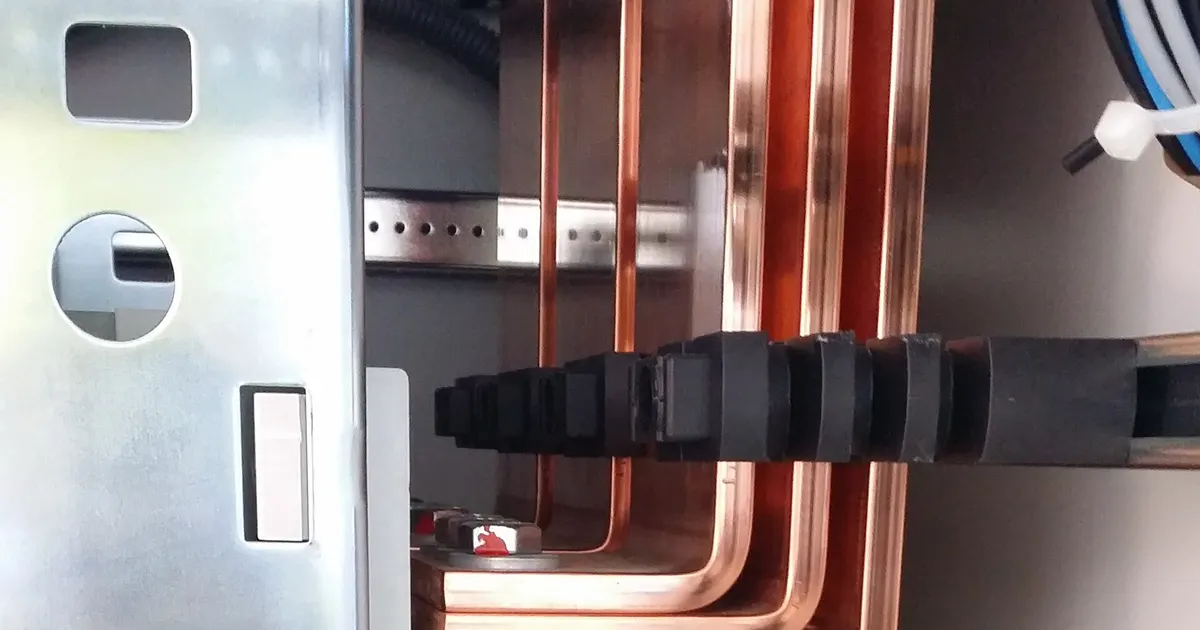
Every battery pack needs conductors that carry hundreds of amps between cells, modules and terminals. Those conductors are usually busbars: flat copper or aluminum parts, blanked, punched and bent to fit. They look simple, but the print carries more electrical and mechanical requirements than most brackets, and an RFQ that leaves them out gets quotes that cannot be compared.
This guide lists what a shop needs to price a busbar correctly, with the reason behind each item.
What a busbar does
A busbar carries current with low resistance and low heat. Its cross-section, thickness times width, sets how much current it can carry for a given temperature rise, and its length and joints set the voltage drop. In an EV pack, busbars link cells, join modules and connect the pack to the power electronics. Some are flat strips with holes for bolts. Others are bent into shapes that route around other parts. Laminated busbars stack several copper layers separated by thin insulation, to lower inductance in power electronics.
The stamper does not size the current path. The designer does. The stamper must hold the cross-section, the surface and the geometry the designer set, and keep the part clean.
Material: copper or aluminum
Copper. C11000, electrolytic tough pitch copper, is the common busbar alloy, with conductivity near 100 percent IACS. It bends easily in a half hard temper, welds to cell tabs and plates well. It weighs about three times as much as aluminum for the same volume. Higher purity oxygen-free copper is used when welding or hydrogen conditions require it.
Aluminum. Alloys such as 1050, 1350 and 6101 are used for lighter and lower cost busbars. Conductivity is about 60 percent IACS for these grades, so the cross-section must be roughly 60 percent larger to carry the same current. Aluminum forms an oxide that raises contact resistance, so joints need surface preparation, plating or a different joining method. Copper to aluminum joints need care because of galvanic corrosion.
See copper, brass and phosphor bronze strip for stamping for the copper alloy basics and aluminum stamping alloys for the aluminum side.
Temper and thickness
Copper busbars are usually supplied in a half hard temper, which holds a bend and stays flat. Soft temper bends more easily but dents and bows more. Harder tempers resist bending and crack at tight radii. State the temper by code, such as C11000 H02, and the minimum bend radius.
Thickness for cell and module busbars commonly runs from a few tenths of a millimeter to a few millimeters. Thicker bars, several millimeters, are used for high current links and pack terminals. Thickness tolerance matters because it changes cross-section directly. See coil thickness and width tolerance for what to ask the shop to hold.
Burr: the busbar specific requirement
Burr limits on busbars are often tighter than on mechanical parts, for three reasons:
- A burr can pierce insulation, such as a coating, film or sleeve, and create a short path.
- A sharp burr concentrates electric field, which can cause partial discharge at high voltage.
- A burr on a contact face stops the busbar from seating flat on a terminal, which raises contact resistance and heat.
State the burr limit as a number and the direction as a face. A common approach is to set a small limit, in the range of a few hundredths of a millimeter, on the mating faces and a looser limit elsewhere. Copper is soft and makes tall, ductile burrs, so shops often add tumbling, brushing or a shaving step. Note that deburring after plating removes coating. See stamping burr height for measurement and callouts.
Edges, corners and flatness
Insulated busbars need rounded edges and corners, since sharp corners cut through coatings. Many prints specify an edge radius or a break. Flatness matters at the contact area, where the busbar presses on a terminal or cell tab, so the print should give a flatness limit and the area it covers. Long thin copper strip bows after blanking, and shops often flatten parts after stamping. Ask which method the shop uses, since it affects both cost and cleanliness.
Plating and surface
Bare copper tarnishes and its contact resistance rises over time, so busbars are usually plated. Common finishes are:
- Tin, for corrosion resistance and low contact resistance, typically a few micrometers thick
- Nickel, for hardness, heat resistance and laser weld compatibility with cells
- Silver, for the lowest contact resistance in high current joints
Name the finish, the thickness, the standard and whether the whole bar or only the contact areas need plating. Plating after stamping covers the edges, and pre-plated strip does not. See pre-plated strip vs plating after stamping. Where a busbar is laser welded to a cell tab, the surface condition and plating decide weld quality, so confirm the finish with the pack designer.
Insulation and handling
Many busbars are insulated after stamping with a powder coat, a dip coat, a heat-shrink sleeve or a laminated film. Insulation covers the whole bar except the contact areas, so masking or a bare window is part of the process. State which areas must stay bare, and the dielectric requirement the coating must meet. Handling matters too. Fingerprints and scratches on copper can affect contact and appearance, so shops use gloves, interleaf paper or trays and corrosion-inhibiting packaging. Specify the packaging on the RFQ.
Die choice
Small cell busbars, with a flat outline, a few holes and a bend, fit a progressive die at high volume. Long busbars exceed what a strip can carry, so shops cut a blank to length from coil, punch it in a die and bend it in a press brake or a second die. Very low volumes use laser or waterjet cutting and a press brake. Copper is soft, so tool wear is mild, but sticking and burr need attention. See progressive die vs transfer die vs deep draw.
Tolerances
Hole position and pitch matter, because busbars bolt onto fixed terminals. Typical callouts are hole position within a tenth of a millimeter or so for small bars and looser for long ones, flatness over the contact area and bend angle. Put the tight features on the datum scheme and loosen the rest. See metal stamping tolerances.
Joining to cells and terminals
How the busbar is joined decides several print requirements. Cell tabs are often laser or ultrasonically welded to the busbar. Laser welding copper is harder than welding nickel or steel, because copper reflects much of the beam, which is one reason nickel plating appears on copper busbars. Ultrasonic welding needs a flat, clean surface and a controlled hardness. Bolted joints need flat faces and a defined hole size, and they rely on plating to keep contact resistance low.
Tell the shop the joining method and the weld area, because flatness, surface finish and plating thickness in that area need to be held tighter than elsewhere. If the weld area is a specific window on the busbar, mark it on the print with its size and position. A shop that knows where the weld lands can keep that area clean and protected during later steps.
Inspection and records
Busbar prints tend to ask for more measurement than a typical bracket. Common checks include:
- Dimensions and hole positions, by coordinate measuring machine or vision system
- Flatness of contact faces
- Burr and edge condition, by microscope or profile measurement
- Plating thickness, usually by X-ray fluorescence
- Conductivity or hardness of the material, from the mill certificate or a test on the part
- Insulation integrity, such as a dielectric withstand test on coated bars
- Visual inspection for scratches, tarnish and contamination
Ask how often each is done and what the shop records. For automotive programs, many buyers expect lot traceability back to the coil and the plating batch, and a production part approval package. The PPAP primer explains the documents.
Cost drivers
Copper is the largest line in most busbar quotes. Price follows the metal market, and the skeleton scrap from blanking carries real value, so ask how the quote treats it. Beyond the metal, the main drivers are:
- Material yield. A layout that nests bars tightly saves copper. Long, thin or odd shaped bars nest poorly.
- Number of operations. Each bend, coin or secondary step adds cost.
- Plating and insulation. These are often a large share of the finished price.
- Inspection and packaging. Tight flatness and clean-room style handling cost more than loose bars in a tote.
- Volume and release pattern. Pack programs ramp quickly, so a shop needs notice to plan coil and plating capacity.
Designers can lower cost by letting the shop propose a nesting-friendly outline, by avoiding tight burr limits on edges that do not matter and by combining plating areas. A short discussion with the shop before the print is released often saves more than negotiating the price afterward. See how to read a metal stamping quote for the line items to compare.
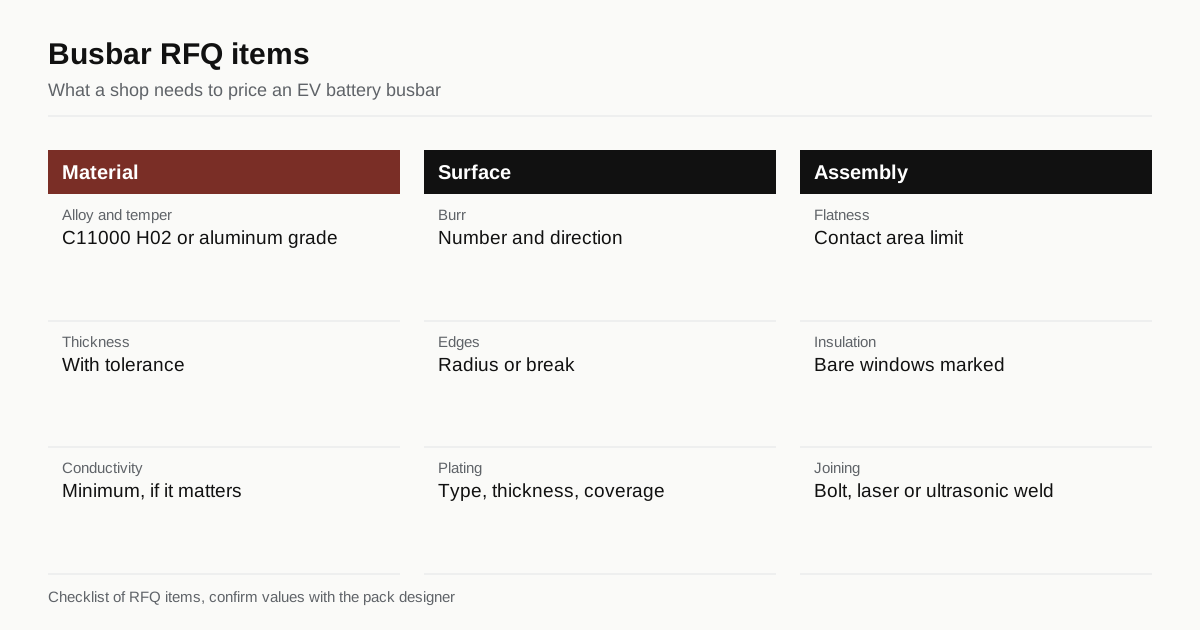
What to put on the RFQ
- Material, alloy, temper and thickness, with tolerance
- Minimum conductivity, if it matters
- Burr limit, direction and affected faces
- Edge radius and corner requirement
- Flatness limit and area
- Plating type, thickness, standard and coverage
- Insulation type, bare areas and dielectric requirement
- Welding or joining method used at the cell or terminal
- Cleanliness and packaging
- Quality documents and traceability
- Annual volume and program length
The metal stamping RFQ checklist lists the other fields.
Checklist before you send
- Confirm material, temper and cross-section with the pack designer.
- Set burr limit and direction as numbers.
- Mark the contact faces for flatness and plating.
- Decide how the bar is insulated.
- State the joining method.
- Write the packaging requirement.
When the print is ready, send the RFQ and compare shop replies within 24 business hours.
Frequently asked questions
Should an EV busbar be copper or aluminum?
Copper carries more current for a given cross-section and welds and plates easily, but it is heavier and costs more. Aluminum is lighter and cheaper per unit volume but needs a larger cross-section and a more careful joint to the cell or terminal. The choice follows current, weight, space and the joining method.
Why does burr matter on a busbar?
A sharp burr can pierce insulation, create a high-field point or stop a contact face from seating flat. Many busbar prints set a tight burr limit with a stated direction.
Can busbars be stamped in a progressive die?
Small cell-to-cell busbars often are. Long busbars are more often cut to length from strip and then punched and bent in separate operations, because a progressive strip cannot carry a long part.
Need a quote for this part?
Send the print. We match you with up to 3 stamping shops and reply within 24 business hours.
Send my RFQ